Rules
Part of Starting a Content Marketing Strategy: Begin With the Business Constraint
6 Content Marketing Strategy Checks Before Signing Off
content marketing strategy checklist for 2027 covers audience, purpose, evidence, topics, formats, accessibility, distribution, operations, metrics, and upkeep.
What to take away
- Complete the checklist before approving a program and repeat it when the audience, offer, market, evidence, platform, capacity, law, or performance changes.
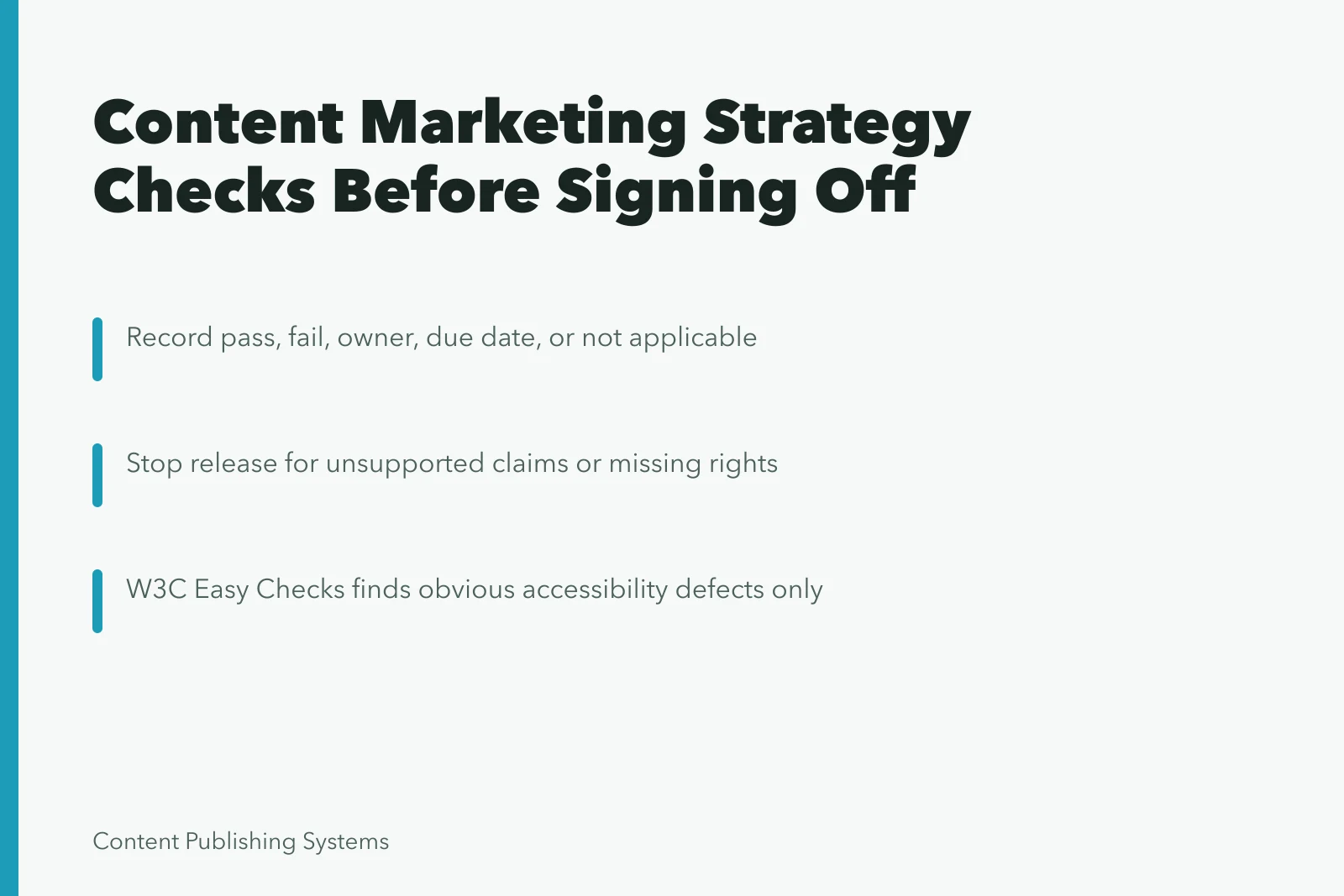
- Record pass, fail, assigned with an owner and due date, or not applicable with a reason; do not turn uncertain items into silent approvals.
- Stop release for material unsupported claims, missing rights, deceptive commercial context, exposed sensitive data, inaccessible essential content, or unresolved contradictions.
A content marketing strategy checklist should reveal the choices and evidence behind the publishing plan.
Business and audience
- Business model, market, offer, customer value, constraints, reputation, sales and service motion, and strategic decision are defined.
- Audience situations, tasks, triggers, stakes, questions, vocabulary, alternatives, barriers, evidence standards, access needs, and markets use traceable research.
- The content mission states whom the program helps, with which problems, through what distinctive evidence, toward what useful result, and within which boundaries.
- Audience outcomes connect to business outcomes through explicit assumptions rather than traffic alone.
Topics and content
The U.S. Copyright Office's copyright basics circular explains that U.S. copyright protects original works fixed in a tangible medium, arises automatically when a work is created and fixed, and is distinct from ownership of a physical or digital copy. Use the current circular to trigger a rights review for text, research, images, audio, video, and commissioned work.
The audience research and mission work in content marketing strategy development should already have produced most of the inventory below before the checklist runs.
- Existing pages, help material, sales assets, research, media, tools, and expert knowledge are inventoried before new production.
- Topic clusters follow audience problems and tasks, with scope, primary page, supporting questions, overlap rules, evidence owner, and update plan.
- Format matches the job; not every question becomes an article, video, lead form, or search-targeted page.
- Editorial rules cover accuracy, sources, first-hand evidence, authorship, claims, rights, disclosures, accessibility, corrections, and higher-risk review.
Channels and experience
W3C's Easy Checks accessibility review offers a first-pass examination of page titles, headings, contrast, keyboard access, forms, images, and multimedia. It is not a complete accessibility evaluation. Use it to find obvious defects, then test the actual templates, pages, media, journeys, languages, and assistive-technology conditions in scope.
- Each channel has an audience behavior, role, format, permission, owner, cost, shelf life, dependency, and measurement plan.
- Distribution, partner use, outreach, email, social adaptations, sales enablement, product placement, and follow-up are planned before production.
- Titles, headings, links, image alternatives, captions, transcripts, instructions, language, keyboard use, and representative assistive-technology tests are included.
- Next actions help the reader progress without deceptive gates, false urgency, hidden commercial intent, or unnecessary data collection.
Operations and learning
- Workflow names research, brief, draft, factual, specialist, accessibility, rights, edit, production, approval, distribution, correction, and retirement owners, and content marketing strategy mistakes lists the calendar-led and traffic-only patterns a passed checklist can still hide.
- Budget covers expert time, data, media, promotion, tools, localization, accessibility, updating, support, and archive, not only initial writing.
- Measures define source, population, event, window, attribution, privacy, baseline, target range, decision rule, and platform limitations.
- Review triggers, correction path, consolidate, redirect, annotate, unpublish, archive, replacement, and retirement choices have owners.
Use the checklist as a decision record, not a score that hides important failures.
Checklist disposition record
| Status | Required evidence | Next action |
|---|---|---|
| Pass | Reviewer, scope, proof, date | Approve and monitor |
| Assigned | Gap, owner, due date, dependency | Resolve before gate |
| Fail | Material defect or contradiction | Stop, correct, or withdraw |
| Not applicable | Reason, scope, authorized reviewer | Recheck after change |
Record the gate result
The W3C Privacy Principles statement gives web-system designers shared privacy concepts and warns against shifting privacy work to individuals. Apply it to content marketing strategy checklist, then review the governing law.
The CISA software acquisition fact sheet covers development practice, supply-chain exposure, and vulnerability management. Add those government-acquisition questions to the review without treating them as local approval. A decision record answers the common content marketing strategy questions about mission, audience, cadence, measurement, and ownership.
Common questions
Does a completed checklist prove the strategy will work?
No. It records whether defined controls were examined. Audience response, market conditions, execution quality, and business outcomes still require measured learning.
Who should sign off on the checklist?
Name one accountable program owner and preserve each specialist's limited scope, evidence, exceptions, date, and conditions rather than implying one person verified everything.
When should the checklist be repeated?
Repeat it on schedule and after material changes to audience, offer, source, claim, rights, format, channel, platform, data, automation, owner, law, performance, or risk.