Strategy
Part of Starting a Content Marketing Strategy: Begin With the Business Constraint
Reading Content Marketing Strategy Benchmarks Without Fooling Yourself
content marketing strategy benchmarks for 2027 compare internal baselines for discovery, use, progress, production, quality, cost, upkeep, and business decisions.
What to take away
- Start with an internal baseline built from stable definitions, comparable content, a stated population, a time window, and known collection limits.
- Separate discovery, content use, audience progress, production, quality, cost, and business contribution so one attractive number does not hide a weak system.
- Use an external report as context only after checking its sample, market, dates, definitions, exclusions, sponsors, medians, distributions, and comparability.
Content marketing strategy benchmarks in 2027 should compare like with like and support a decision. There is no universal healthy traffic, engagement, conversion, output, or word-count number for every business.
Start with an internal baseline
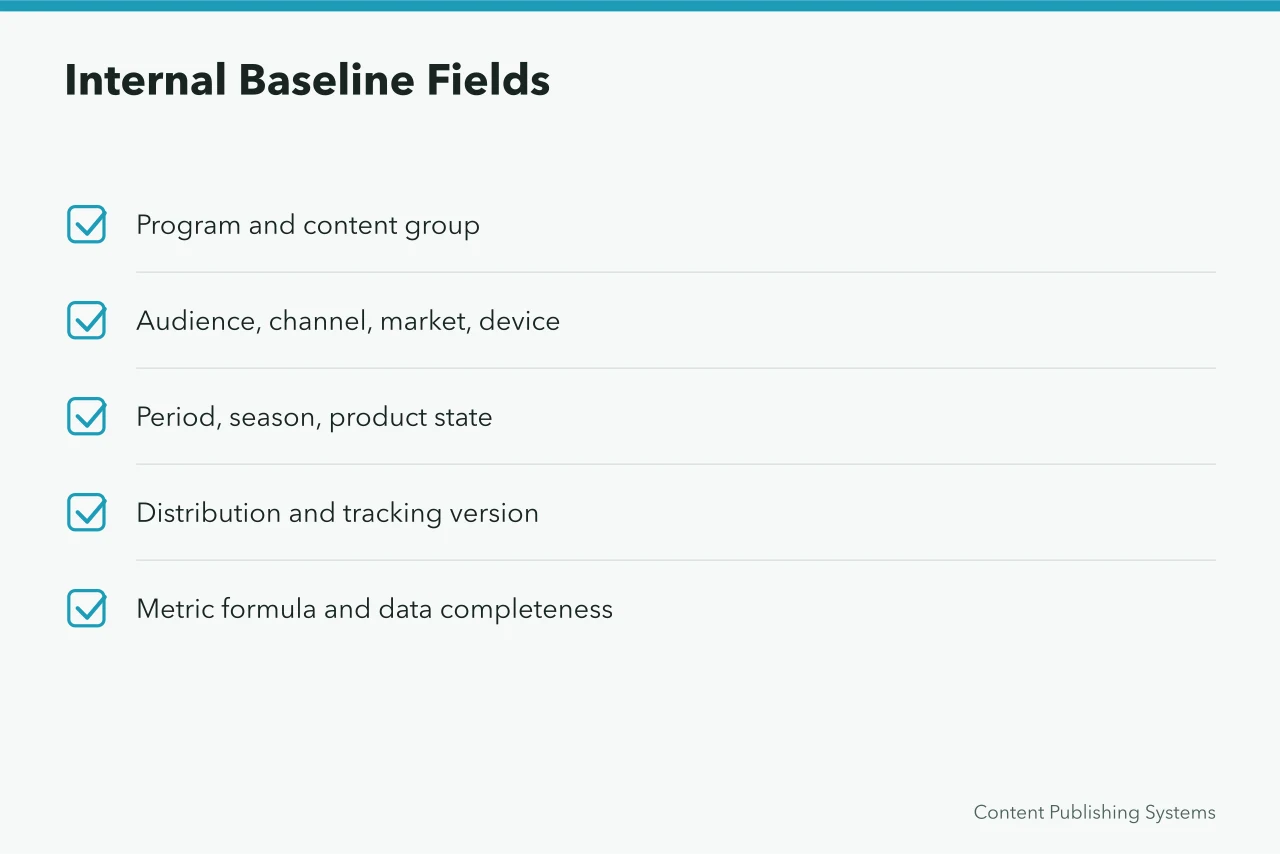
Record the program, content group, audience, channel, market, device, period, season, product state, distribution, tracking version, metric formula, and data completeness. Compare a stable cohort with its own previous periods before seeking an external average. Use medians, ranges, and counts where one exceptional page can distort a mean.
Benchmark discovery
Google's Search Console metric definitions cover impressions, clicks, click-through rate, and average position, and warn counting and position depend on result type.
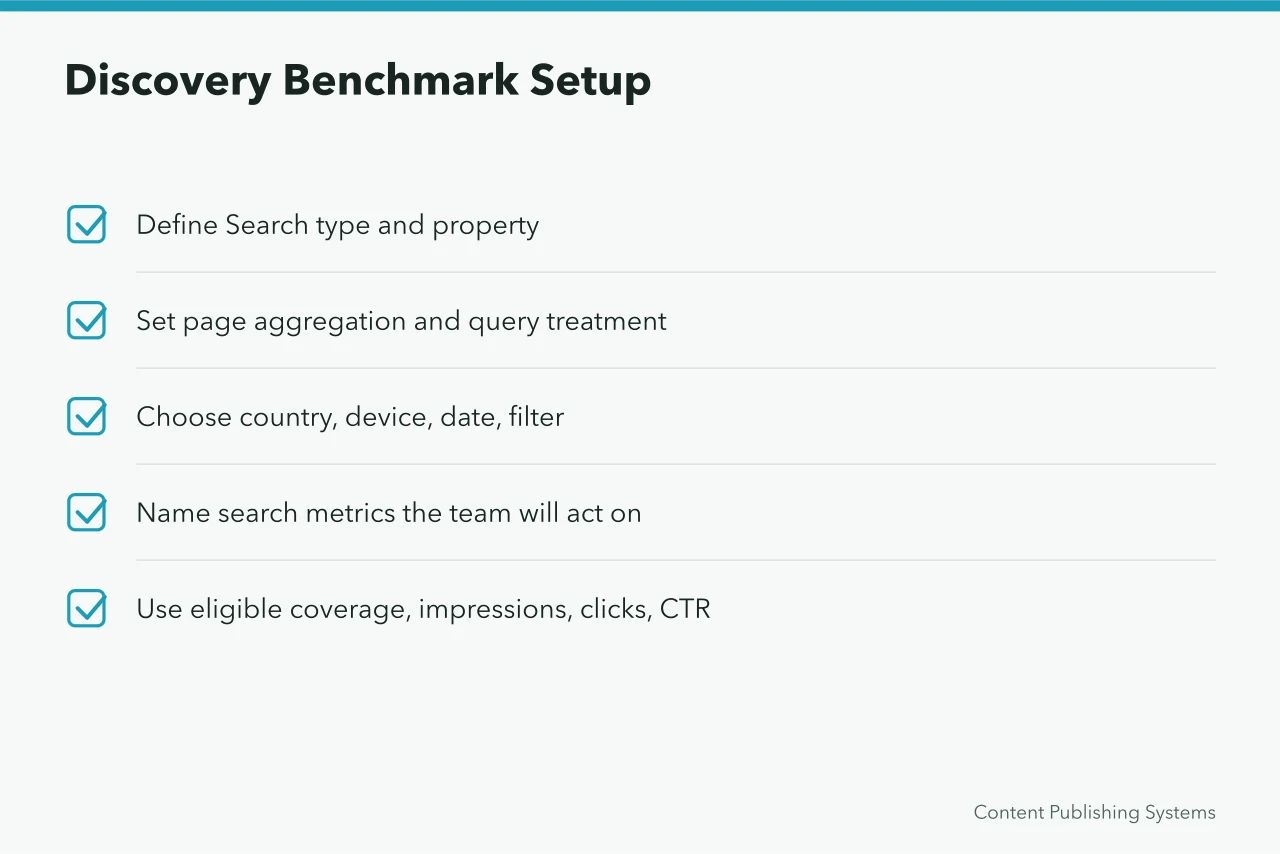
Before calling a change a benchmark, define Search type, property, page aggregation, query treatment, and country. Set device, date, filter, and comparison, and name search metrics the team will act on in a content marketing strategy development plan.
Use eligible coverage, impressions, clicks, click-through rate, queries, countries, devices, and content shown by channel. Google recommends focusing more on impression and click trends than position alone.
Benchmark use and progress
Google Analytics' content-group instructions say content groups categorize pages and screens into custom buckets so teams can view metrics for related information. The page documents the content_group parameter and reporting through the Pages and screens report or explorations. A grouping can support cluster analysis, but its results still depend on implementation, consent, events, identity, filters, and a defined decision.
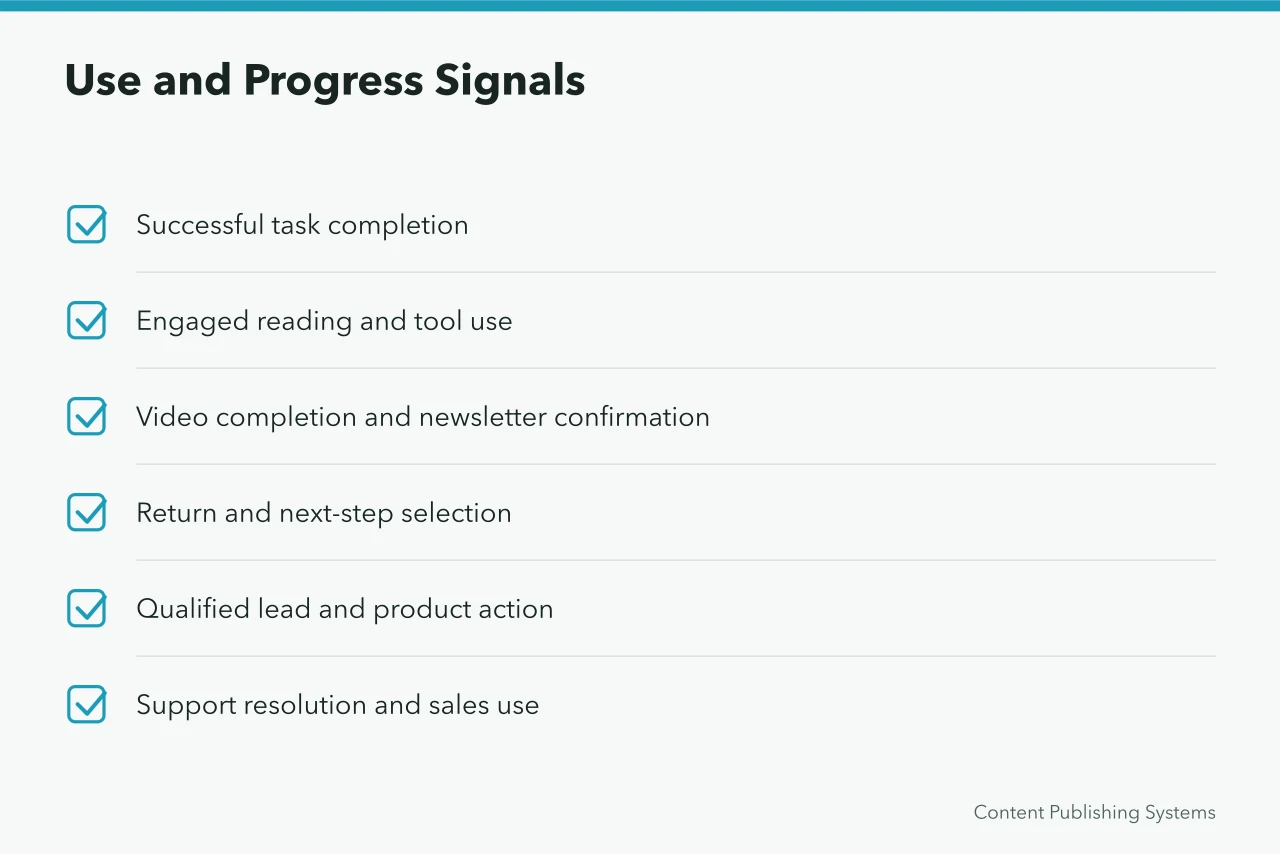
Measure successful task completion, engaged reading, tool use, video completion, newsletter confirmation, return, next-step selection, qualified lead, product action, support resolution, or sales use according to the content's job. Content marketing strategy checklist works through the same program, audience, and tracking fields as a gate before a benchmark is trusted.
Benchmark production and quality
Track research time, expert time, cycle time, approval time, revision rounds, accessible-template use, evidence defects, rights defects, corrections, distribution completion, localization effort, update backlog, stale-content exposure, and cost per maintained asset. Avoid a raw publishing quota, and read this operating data beside the discovery and use benchmarks above rather than in isolation.
Use external reports carefully
Before using an industry study, inspect sponsor, sample frame, respondents, markets, and business sizes. Inspect question wording, field dates, weighting, exclusions, and definitions. Check missing data and whether results describe behavior or performance.
Label vendor, self-reported findings. Do not turn a survey majority into a target or imply correlation identifies a cause. Content marketing strategy mistakes covers the calendar-first and traffic-only habits that make an imported figure feel like a target.
Set a decision range
Choose a baseline range, desired movement, minimum useful difference, observation window, cost, guardrail, owner, and action if the measure rises, stays flat, or falls. Segment before reacting. A lower page count can accompany better task completion; a lower conversion rate can follow broader qualified reach.
Benchmark definition record
| Measure class | Example baseline | Required limit |
|---|---|---|
| Discovery | Eligible impressions and qualified entries | Platform and query scope |
| Use | Task completion or depth signal | Implementation and intent |
| Quality | Correction and accessibility defects | Review sample and severity |
| Operations | Lead time, cost, update backlog | Workflow and labor boundary |
| Business | Assisted decision or retained account | Attribution and time window |
Make the comparison reproducible
The GAO evaluation design guide connects evaluation questions with evidence needs and design choices. Apply that discipline to content marketing strategy benchmarks; federal evaluation guidance does not make a local marketing result causal or transferable.
The NIST experimental design selection guidance begins design choice with the objective and constraints. It separates benchmark reporting from controlled effect estimates, not observation from causation.
Common questions
What is a good content marketing benchmark?
A useful benchmark is comparable, defined, decision-linked, and honest about collection limits. The right range depends on the audience, task, format, channel, market, maturity, cost, and risk.
Should competitors set the target?
No. Competitor observations can suggest questions, but they rarely reveal compatible definitions, data quality, cost, conversion logic, audience mix, or business constraints.
How often should benchmarks change?
Change a definition only with documented reason and preserve the old series. Update target ranges when strategy, market, capacity, data collection, audience behavior, or risk changes materially.