Strategy
5 parts of anniversaries and archives this week, explained
Anniversaries and archives: how date-based features and automated reminders push old death notices back into view years later, and how to reduce harm.
Old pages do not sit still. Something surfaces them: a date-based feature, a platform reminder, a recommendation engine, a round-number anniversary. The family did not choose the timing and usually did not know it was coming.
No person is named here and no death is reported. What follows is about resurfacing and what can be done about it.
What to take away
- Resurfacing is a publishing decision even when a machine makes it, and somebody in the organization owns it whether or not they know they do.
- The harm is almost entirely about timing and framing rather than about the content, which was fine when it was published.
- The two cheap fixes are a way to opt out and a rule against automatic anniversaries for the recently bereaved.
What actually pushes old pages back up
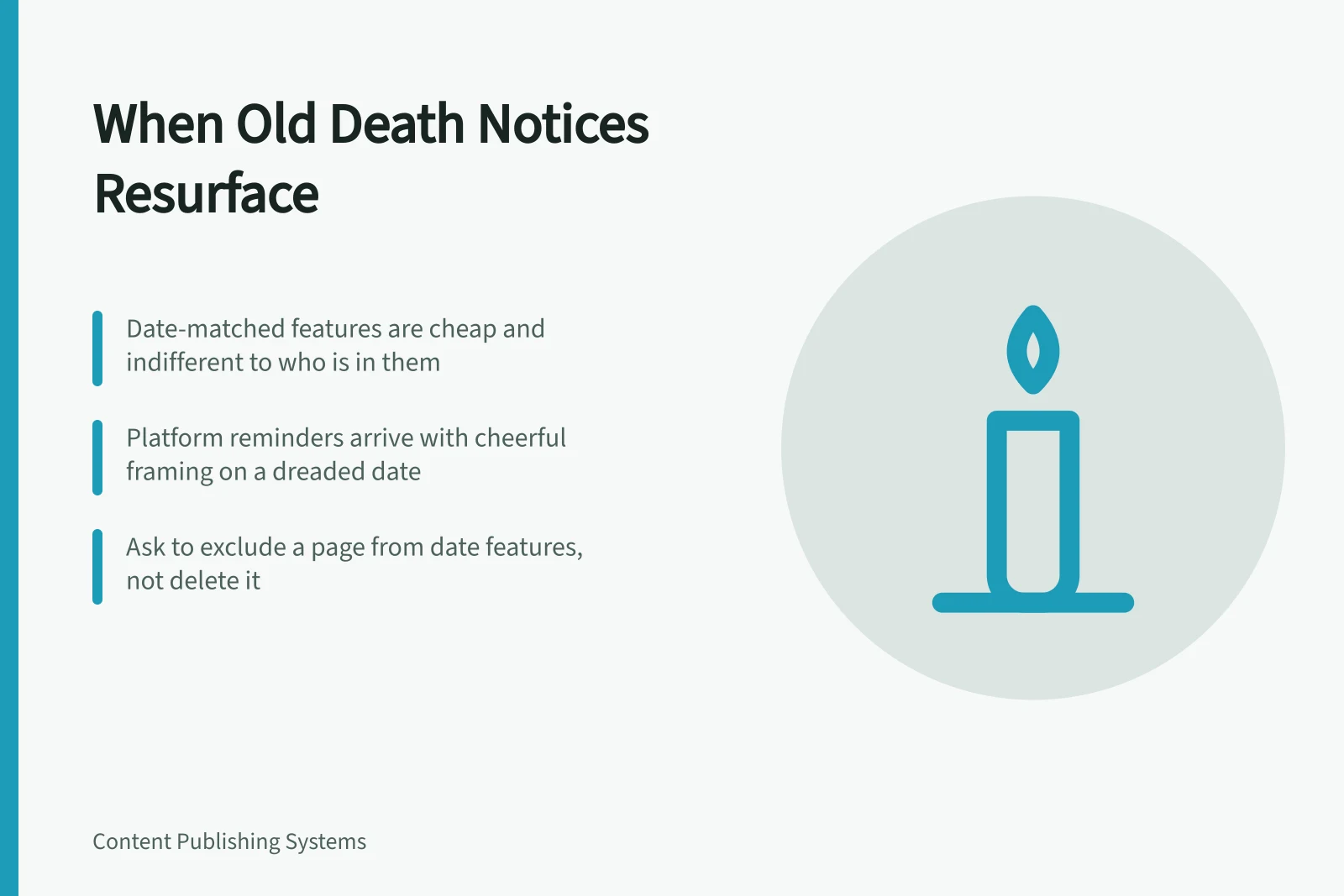
Date-matched features. A weekly or daily slot built from what happened on this date. Cheap to produce, reliably read, and completely indifferent to who is in it.
What Resurfaces Old Pages
- Date-matched featuresweekly or daily slots
- Platform remindersmemories and anniversaries
- Recommendation systemsrelated material
- Round numbersten, twenty-five, fifty years
- Searchfirst result when someone is looked up
Platform reminders. Memories, anniversaries, and "you posted this" prompts, generated for the person who posted rather than for anyone in the post.
Recommendation systems. A page gets attention for an unrelated reason and the system offers related material, which on an archive of this kind means other deaths.
Round numbers. Ten years, twenty-five years, fifty. Editorially deliberate and therefore the one that is most defensible and most predictable.
Search. Not resurfacing exactly, but the reason a page from years ago is the first thing anybody finds when they look somebody up. It sets the context for everything else.
Why it lands badly
The page has not changed. What has changed is who is reading it and when.
A notice written days after a death was for people who already knew. Read cold years later by someone who did not, it can be how they find out.
An anniversary feature reaches a family on a date they already dreaded, from a direction they did not expect. A platform reminder arrives with the cheerful framing of a memory, attached to the worst week of somebody's life.
There is also a slower harm. A person who dies young acquires a permanent search result in which the death is the headline, and that becomes the first fact about them for everybody who looks. Nothing in any individual page is wrong. The aggregate is a distortion, and no one page is responsible for it.
What a publisher can do
- Flag the material. An archive that knows which of its pages are death notices can apply different rules to them without a human reviewing each one.
- Exclude recent material from automatic date features. Any threshold is arguable; having one is not.
- Give families a route to opt a page out of resurfacing without asking for it to be deleted. This is the request most people actually want to make, and almost nobody offers it.
- Do not resurface with new framing. Reposting an old notice as though it were news is the single most complained-about behavior in this area.
- Answer requests from a named address, and say what you will and will not do. Broader thinking on where harm arises in this kind of publishing is collected in Poynter's ethics and trust material, and most of it comes down to deciding in advance rather than case by case.
What a family can ask for
The useful thing to know is that there is a middle option between leaving a page alone and demanding it be deleted, and it is the one most likely to be granted.
Ask the publisher to exclude the page from date features, recommendations, and automatic reminders, but keep it available to anyone who looks for it.
If a specific detail is causing harm, ask to have that detail removed.
Separately, ask that search engines be told not to index it, a different request a publisher may or may not agree to.
Full removal is a bigger ask with a lower success rate. Erasure rights of the kind regulators describe, such as the UK guidance on your right to get your data deleted, are framed around information about living individuals. A request about someone who has died usually rests on the publisher's own policy.
A living relative's own details inside the same page are a separate question. Rules differ by country; ask the regulator that covers you.
Where this sits
The parent page on anniversaries and archives covers what an archive holds and what an anniversary piece is for. For the notice forms themselves, see deaths this week, and for records organized by year, where anniversaries cluster, deaths by year. For the first days, when none of this is yet a problem, see deaths today.
Common questions
Who decides that an old page reappears?
Somebody set up the feature or the system. The decision is a policy, made once, and it is owned by whoever can change it.
Can I stop platform reminders about a death?
Platform settings control some of them, and each platform is different. The reminders generated for other people's accounts are not within your control at all.
Is it wrong to publish anniversary pieces?
No. They are often welcome, particularly for public events, and families sometimes take part. The problems come from doing it automatically and doing it early.
What is a reasonable threshold before a death appears in a date feature?
There is no correct answer, and a published policy is worth more than the number in it. What matters is that recent bereavement is excluded and that families can ask for an exception.
Will a publisher tell me if a page is going to resurface?
Rarely, because most resurfacing is automatic. It is a reasonable thing to ask for, and some will agree to it for a specific page.