Strategy
Part of Guide to Content Planning Before You Schedule a Single Deadline
Evidence Records Are Reshaping Content Planning: Away From Guesswork
content planning trends for 2027 cover evidence records, governed AI, accessibility estimates, content groups, distribution commitments, and maintenance capacity.
What to take away
- These six trends are planning hypotheses based on material reviewed in September 2026, not forecasts, adoption statistics, ranking promises, or universal recommendations.
- Evidence records, governed AI, accessibility estimates, content groups, distribution commitments, and maintenance capacity each need a bounded measurable pilot.
- Adopt a direction only when it improves a defined decision without weakening accuracy, originality, rights, disclosure, access, privacy, ownership, correction, or exit control.
Content planning trends are useful as testable operating hypotheses, not confident forecasts. The six developments below follow current search, analytics, advertising, and accessibility guidance as of August 2026.
1. Plans will carry evidence records
Digital.gov's structured-content introduction describes organizing content as modular information tagged with machine-readable metadata so it can be found, understood, shared, used, and reused, with consistent taxonomies for elements such as titles, dates, and contributors. That federal model supports a reusable evidence record, but reuse still requires context, rights, accuracy, access, and lifecycle controls.
Teams increasingly need to preserve who made material claims, how information was gathered, why the content exists, which source supports it, what limitations apply, and when it must be checked again.
2. AI use will move behind gates
NIST's voluntary AI RMF Manage Playbook suggests deciding whether an AI system should proceed, prioritizing documented risks, reviewing risk tolerance, monitoring third-party resources, handling unexpected harms, and decommissioning systems that exceed tolerance. It is risk guidance, not proof that a reviewed output is accurate, original, lawful, accessible, private, or useful.
Automation can assist classification, transcription, formatting, variants, and workflow, but planning systems need approved inputs, prohibited data, accountable review, fact verification, rights checks, disclosure decisions, and audit records, the same fields a content planning checklist already asks a team to name.
3. Accessibility will affect estimates
Captions, transcripts, meaningful links, text alternatives, readable instructions, accessible downloads, and keyboard-compatible experiences require time and ownership. W3C guidance makes these needs visible.
4. Plans will organize content groups
Instead of judging every URL alone, teams can organize related material by audience task, product, journey, market, format, or strategic theme. Google Analytics supports content grouping, while Search Console supports performance analysis with important aggregation limits.
5. Distribution will become a commitment
A publish date without a reachable first audience is a production event, not a complete go-to-market plan. Expect briefs to record channel, owner, adaptation, permission basis, timing, cost, and follow-up. Grouping and scheduling that record is exactly the kind of structured view a side-by-side look at content planning tools tests directly in Asana and Notion.
6. Maintenance will compete with output
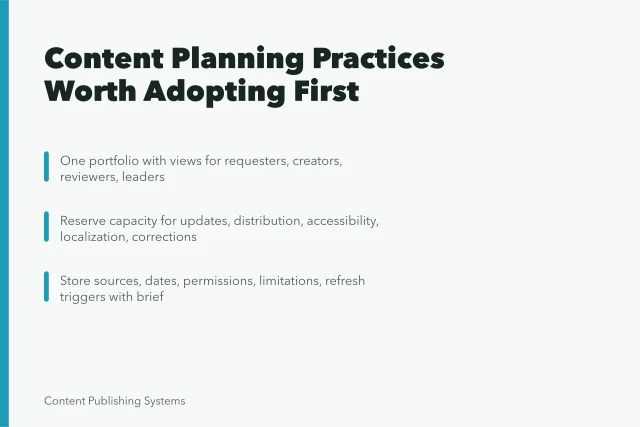
Volatile products, laws, prices, statistics, links, and market claims make indefinite publication risky. Planning portfolios will need explicit refresh, consolidation, redirect, archive, and retirement capacity. Track maintenance exposure beside new production rather than hiding it in an editorial backlog.
Run a quarterly trend test
Choose one operational hypothesis, set a baseline, define the intervention, primary measure, guardrails, owner, duration, and decision rule, then pilot it with a bounded portfolio. Record confounders and negative results.
Trend pilot decision record
Trend pilot decision record
Does context survive approved reuse?
Evidence records hold
Claim meaning changes
| Hypothesis | Pilot evidence | Stop condition |
|---|---|---|
| Evidence records | Context survives approved reuse | Claim meaning changes |
| Governed AI | Scoped task, review, correction, exit | Unsupported output ships |
| Accessibility estimates | Representative work and testing | Essential path is blocked |
| Content groups | Stable taxonomy and reporting | Grouping hides differences |
| Distribution | Owner, permission, channel outcome | Publishing has no reach plan |
| Maintenance | Exposure, backlog, capacity, action | Stale risk keeps growing |
Maintain a dated watchlist
The NIST AI RMF Playbook offers voluntary AI-risk actions under govern, map, measure, and manage. Use them when AI changes content planning trends; the playbook is not a product ranking or forecast.
The W3C Privacy Principles statement gives web-system designers shared privacy concepts and warns against shifting privacy work to individuals. Apply it to content planning trends, then review the governing law and configuration. Reserving maintenance time up front, rather than after the queue is full, is one of the seven content planning best practices worth adopting early.
Common questions
Are these content planning trends predictions?
No. They are testable hypotheses based on material reviewed in September 2026. Recheck the sources, products, and operating conditions.
Which trend should a team test first?
Choose the smallest reversible pilot tied to the most important uncertain planning decision, not the direction competitors appear to favor.
How should a trend pilot end?
Use a predetermined decision: adopt, adapt, pause, or reject. Preserve the evidence, defects, costs, owner, correction work, and rollback.