Strategy
Part of Guide to Content Planning Before You Schedule a Single Deadline
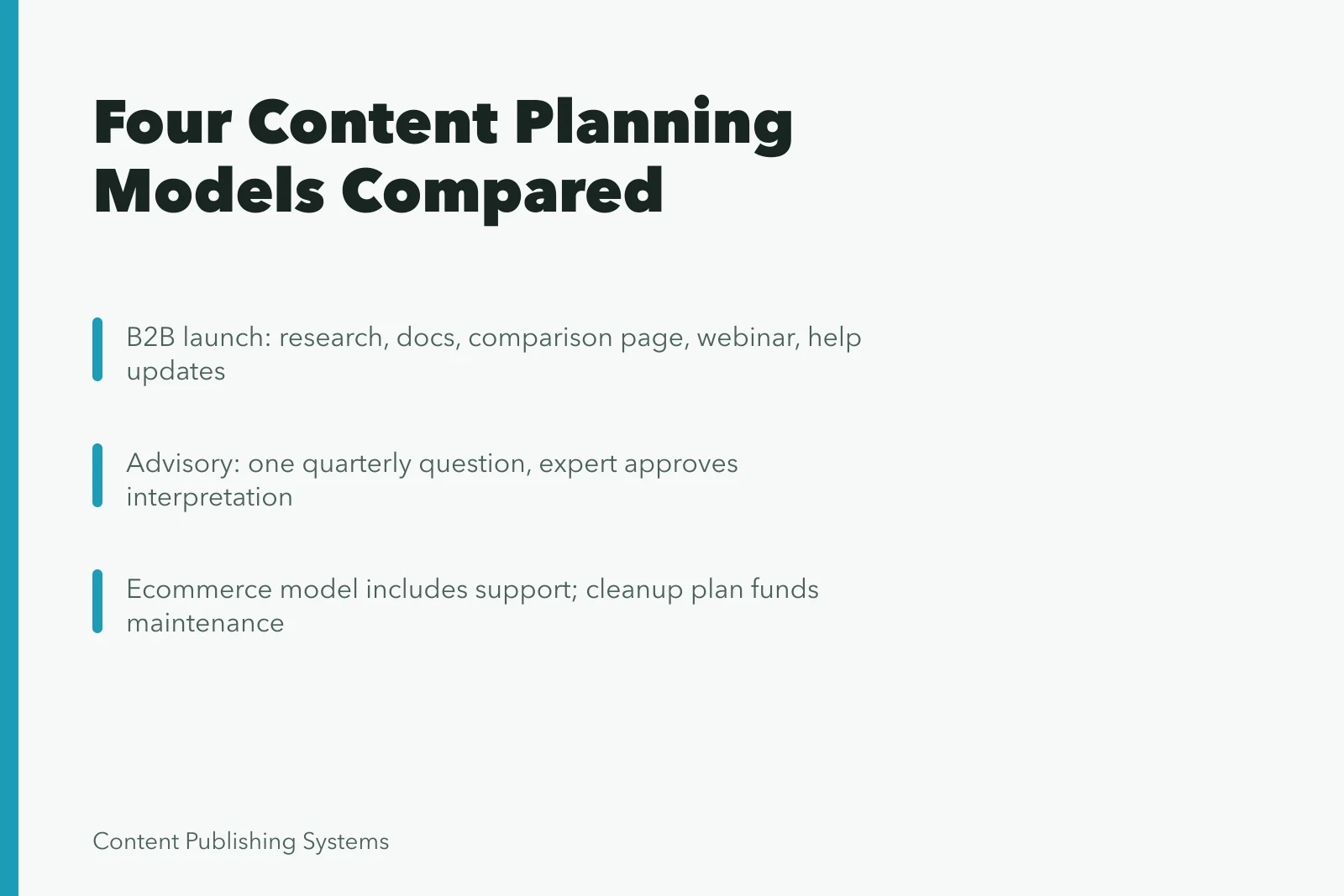
From Launch to Cleanup, Four Content Planning Examples Compared
Four content planning examples from launch to cleanup show how Asana, Wrike, Bynder, and Matomo each solve one distinct editorial calendar problem.
What to take away
- The four content planning examples compared here are Asana, Wrike, Bynder and Matomo. Each publishes a case study or customer story covering a different planning problem: launch, expert time, support demand, and cleanup.
- Asana and Wrike both sell per-seat subscriptions. Asana list prices as of 2026 start at $10.99 per user per month for Starter and $24.99 for Advanced, with a free Personal tier. Wrike starts at $9.80 per user per month for Team and $24.80 for Business, with a free tier for small teams.
- Bynder quotes digital asset management by request. Matomo offers self-hosted analytics free and Cloud from about $23 per month. Ask each vendor for the current figure rather than trusting a list price.
- Every case study below is a vendor's own account of its customer. Read it as a claim with a named source, not as a benchmark.
- The reusable part of each example is the decision pattern, not the tool. Swap in your own audience, evidence owner, and review date.
Content planning examples earn their place when they show a decision someone had to make. Four named tools publish case studies that do exactly that, and each one covers a different stage of the same problem.
Asana: the launch that waits on one approval
Asana sells work management software on a per-seat subscription, with a free Personal tier for up to 10 teammates. Starter costs $10.99 per user per month, Advanced $24.99, and Enterprise is custom. Its published customer stories include product marketing teams sequencing research, documentation, and enablement assets against a fixed release date.
Approval blocks the launch path
- Validate product behavior
- Approve demonstration
- Publish comparison page
- Run launch webinar
The planning problem is the critical path. A comparison page cannot ship before the product behavior it describes is validated, and a launch webinar cannot run before someone approves the demonstration. Map those dependencies before work starts, which is the scheduling step in this 8-step content planning process.
The U.S. Government Accountability Office's Schedule Assessment Guide sets out ten practices for a reliable schedule and treats dependencies as first-class. Its capital-program method is heavier than editorial planning, but the discipline transfers: if one approval blocks the path, the calendar should say so.
Wrike: expert attention as the scarce input
Wrike sells project and work management software, also per seat. Its free tier covers up to 5 users, Team costs $9.80 per user per month, Business $24.80, and Enterprise is custom. The company publishes customer stories through Wrike Case Studies.
Schedule expert time first
- Book the expert interview
- Capture the interpretation
- Run the review window
- Assign formats to surviving evidence
- Cite one controlled evidence record
Its professional-services customers plan around billable expert hours rather than around writing capacity.
That is the second planning problem. An advisory firm's bottleneck is the expert who approves the interpretation, not the writer who drafts it. Schedule the interview, interpretation, and review windows first, then assign formats to whatever evidence survives.
Repurposed pieces should cite one controlled evidence record and carry its limitations forward. Adding certainty at the second use is how a methods note turns into a claim nobody can defend.
Bynder: post-purchase content that earns its place
Bynder sells digital asset management with pricing available on request. Its published customer stories include retail and ecommerce brands managing product content at volume. Those accounts show how much service content depends on approved product facts.
Group service contacts by customer task, then by value and urgency. Sizing guidance, delivery explanations, care instructions, and returns help usually outrank another acquisition page for a retailer with a returns problem.
Support content can reduce confusion, but a page alone rarely proves fewer returns. That claim needs analysis the page cannot supply. Whether post-purchase work belongs in the plan at all traces back to the goals set in a content marketing strategy.
Matomo: the cleanup nobody scheduled
Matomo sells web analytics. Self-hosted On-Premise is free, and Matomo Cloud starts at about $23 per month for 50,000 hits. Its case studies lean on organizations that needed data ownership. The planning lesson sits in the cleanup stage.
A mature library needs a keep, improve, merge, or retire decision per URL. Each decision needs evidence, an owner, a risk note, and a review date. Digital.gov's content-audit method defines an audit as an inventory and analysis of pages, files, video, or other material.
Sample the library when a full inventory is impractical.
Consolidation, fact repair, and retirement all consume research and review capacity. Treat them as spare-time work and the library grows while ownership stays unclear.
Four examples, four planning problems
Tool and pricing
- Asana
- Work management; free Personal tier, Starter from $10.99/user/month
- Wrike
- Work management; free tier, Team from $9.80/user/month
- Bynder
- Digital asset management; quote-based
- Matomo
- Web analytics; self-hosted free, Cloud from about $23/month
Planning problem
- Asana
- Fixed launch date and dependencies
- Wrike
- Scarce expert contribution
- Bynder
- Pre- and post-purchase tasks
- Matomo
- Repair, merge, replace, retire
Failure to test
- Asana
- One approval blocks the path
- Wrike
- Writing planned without experts
- Bynder
- Campaign ignores service demand
- Matomo
- New output consumes all capacity
Turn an example into a test case
The NIST Privacy Framework starting guide describes a voluntary process for identifying and managing privacy risk. Use it to assign data and response owners for the customer material these plans touch. It is not legal clearance.
The W3C information and relationships explanation says visual structure should also be available to assistive technology. Check the output, then test the real page with the users and technology in scope. A roundup of common content planning questions covers the edge cases that keep resurfacing.
Common questions
Are these real content plans?
No. Each is a named tool and its published case study, read for the planning decision inside it. None of them is a client plan, a measured outcome, or a performance forecast.
Which example fits a small team?
Pick the one whose planning problem matches yours, then cut the scope to work you can evidence and maintain. A two-person team with a returns problem should start with Bynder's pattern, not Asana's launch path.
Can the four be combined?
Yes, if each work type keeps its own audience role, evidence owner, effort estimate, and lifecycle decision. Combining them without separate owners is how a plan becomes a calendar nobody follows.