
Guides
Blog and Project Page Content Ideas for Remodelers
Ten blog and project page ideas for remodelers, matched to your situation, with notes on photo rights, customer comments, older homes and town pages.
A remodeler's website can help a homeowner judge fit before the first call. Start with what your crew already knows: the questions people ask at estimates, the choices that stall jobs and the work you want more of. If you already have a backlog of posts, audit it for gaps before adding to it.
Pick your situation, then go to those entries. The numbers do not rank the ideas.
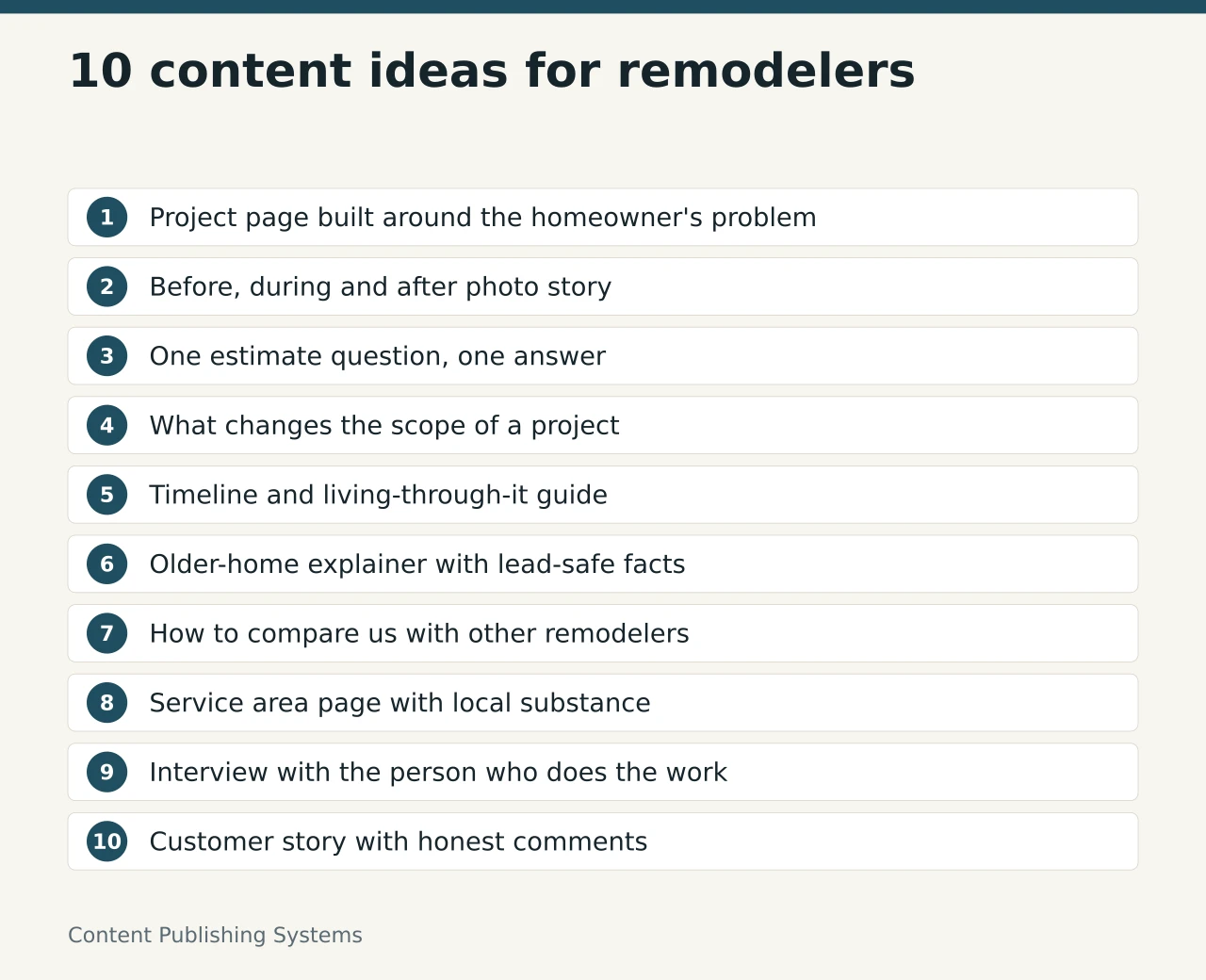
1. Project page built around the homeowner's problem
Open with what was wrong, such as a bathroom with no storage or a kitchen cut off from the dining room. Then cover the constraints, the options considered, the choice made and the result. Name the service and, if the owner agrees, the general area.
Add photos with captions that say what changed. Google's image guidance says it uses alt text along with page content to understand an image, and warns against stuffing that text with keywords. Describe the picture in ordinary words.
Get the owner's written permission, and leave out the street address, faces, family photos and location data stored in image files.
2. Before, during and after photo story
Use this when interesting work ends up hidden. Show the starting condition, one or two stages that the finishes later cover, and the result, shot from matching angles where you can. Explain what each middle photo shows, and avoid presenting one house's repair as the fix for all houses.
Check who owns the pictures. The U.S. Copyright Office says the person who takes a photo is generally its author and first owner, with exceptions for work made for hire. If a photographer, subcontractor or client took the shot, settle permitted uses in writing. Ask an attorney if ownership is unclear.
3. One estimate question, one answer
Keep a shared note where whoever does estimates records questions in the homeowner's words. Turn one into a short post: Can we stay in the house during the work? What has to be chosen before demolition? Can we supply our own fixtures?
Answer in the first lines, then say what would change the answer. Where it depends on a site visit, say so and list what you would look at. Send the link to the next person who asks, and note whether they still have questions after reading it.
4. What changes the scope of a project
For each main job type, explain the decisions and site conditions that can make the work larger or smaller, such as moving plumbing, opening a wall, ordering custom parts, finding damage after demolition or getting materials into a tight space. You can do this without publishing figures.
Use a real job to show one change only if the homeowner agrees and your records support the account. Describe how your firm handles unexpected conditions, and check that description against your actual change order process and contract. If they differ, resolve it before publishing.
5. Timeline and living-through-it guide
Walk through your stages in order, for example from first visit and selections to final walkthrough. For each, say what the homeowner needs to decide or clear out, which rooms or utilities may be out of use, and what commonly makes your crew wait.
Treat permits as a local subject. Name the places a statement applies to, link the local building department, and say who at your firm confirms requirements for each job. Avoid telling readers in a general post that a project needs no permit. Review these pages when a local process or your own scheduling changes.
6. Older-home explainer with lead-safe facts
If you work on older houses, describe what you check before disturbing surfaces and how that can affect preparation. On lead paint, rely on official text. The EPA's renovation, repair and painting program page says anyone paid to do work that disturbs paint in pre-1978 homes must be certified, including sole proprietors.
The same page says some states run their own EPA-authorized programs. Link the program that covers your service area, read its current scope and exceptions, and state only certifications your firm holds. Have the person responsible for compliance review the page and any jobsite photos.
7. How to compare us with other remodelers
Answer the checks a careful homeowner may already be making. The FTC's advice on home improvement scams tells consumers to consider only licensed and insured contractors, get several written estimates and not automatically pick the lowest. It also treats a contractor asking the customer to get required permits as a sign of a scam.
Explain how someone can verify your license where one applies, how to request proof of insurance, what your written estimate describes and who handles permits. Describe your payment schedule only after confirming it fits the rules where you work.
8. Service area page with local substance
Build a town page when you have something specific to say about that town, such as work you have permission to show there, housing types you have worked on there, or how to reach the local building office. Without that, one clear service area page may serve readers better.
Copying a page and swapping the town name is risky. Google's spam policies list, among examples of doorway abuse, domains or pages aimed at particular regions or cities that funnel users to one page. Before publishing, ask whether a resident would learn anything your other town pages do not say.
9. Interview with the person who does the work
Record a short talk with a lead carpenter, designer or project manager about one subject, such as preparing a room for tile. Draft from the recording, then let that person correct it. Use their real name and role, with their agreement.
Google's guidance on helpful content asks whether a page shows first-hand expertise and recommends clear authorship where readers would expect it. A corrected talk also gives you material to adapt into other formats, such as a captioned photo set or an email answer.
10. Customer story with honest comments
Ask the homeowner what prompted the job, what worried them and what they would tell someone planning similar work. Keep their meaning intact. The FTC's endorsement guidance says endorsements must reflect honest opinions or experiences, and that an incentive must not depend on a positive review. Disclose a gift, discount or relationship that could affect how readers weigh the comment.
Never write a testimonial for an imagined customer. FTC staff answers on the reviews and testimonials rule cover fake testimonials, insider disclosures and review suppression. Read them before adding a review section, and take legal questions to an attorney.
Choosing what to publish first
Choose one page that supports work you want and one answer your team repeats often. Before promising more, check who has time to gather photos, get permission, review facts and update old pages. For the wider plan around these pages, see how to improve small business content marketing.