Strategy
How to improve small business content marketing
How to improve small business content marketing by auditing customer needs, evidence, page structure, distribution, calls to action, and measurement.
What to take away
- Audit one representative asset across research, creation, distribution, action, measurement, and maintenance.
- Replace assumptions with interviews and add evidence or experience that another publisher cannot simply copy.
- Fix the weakest customer handoff before spending time on cosmetic rewriting or higher publishing volume.
For teams asking how to improve small business content marketing, start by finding the weakest link between customer need and business outcome. Audit a representative page from idea through research, production, distribution, action, measurement, and maintenance.
Replace assumptions with interviews
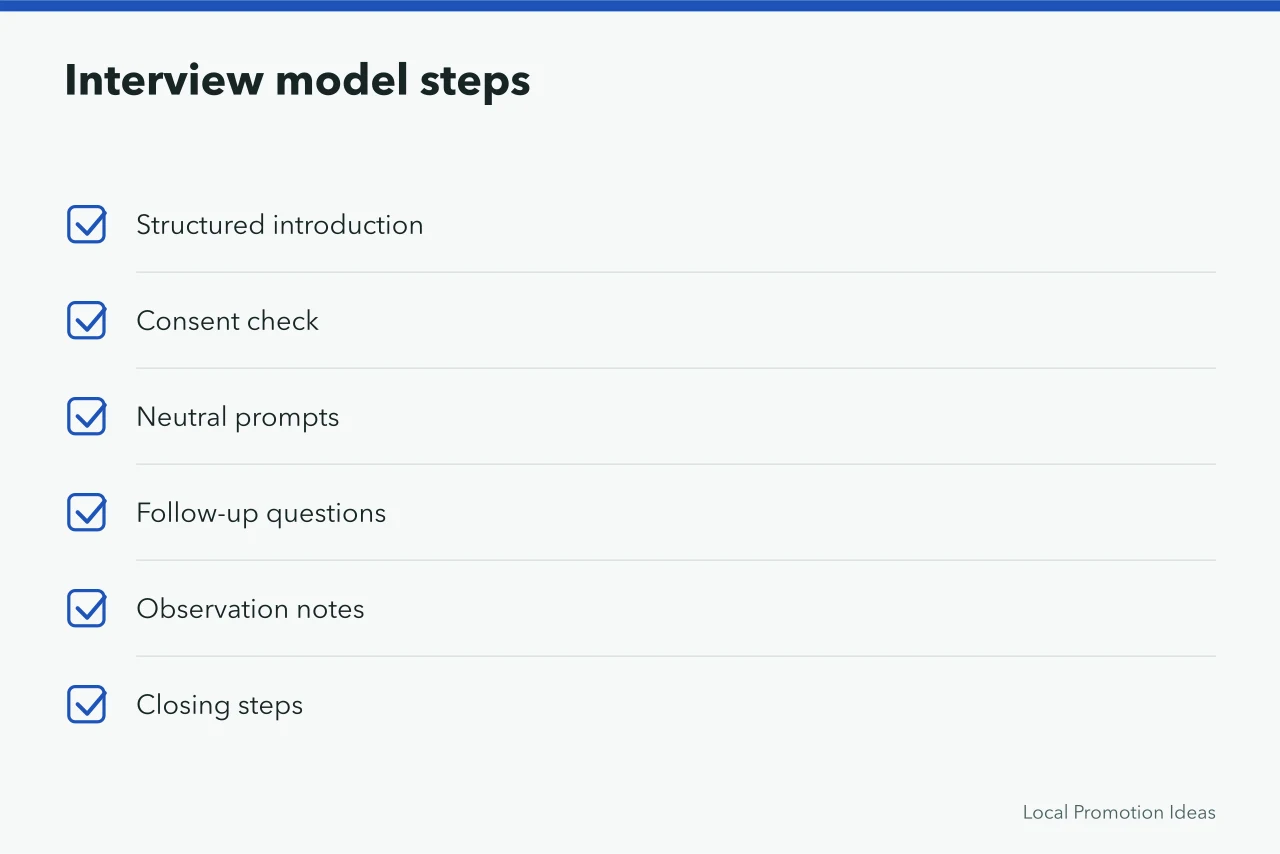
Digital.gov's user-interview model provides a structured introduction, consent check, neutral prompts, follow-up questions, observation notes, and closing steps for public-service research. Adapt the method to your purpose and participants, explain how you will use interview information, and get permission before recording.
Talk to recent buyers, lost prospects, customer-facing staff, and product experts with appropriate permission. Record the situation, exact question, alternatives, objection, consequence, and language. Use recurring patterns to refine the editorial backlog.
Give every page a distinct promise
State what the reader will be able to decide or do after using the page. Consolidate overlapping topics, remove thin variations, and give every surviving asset a distinct audience promise and decision role. A useful pattern is: “For [audience], this page helps you [task] so you can [decision or outcome].” For example, a bakery page could promise, “Compare cake flavors, sizes, and ordering options to choose a cake for your event”; “Learn about our cakes” is too broad to guide a decision.
Add evidence competitors cannot copy
Use a demonstrated process, original photograph, annotated example, expert interview, customer-approved case, first-party finding, tested template, or clear local detail. Identify the author and reviewer truthfully and distinguish direct evidence from interpretation.
Strengthen source discipline
Trace changing or consequential claims to regulators, official documentation, standards, original research, or public data. Record dates and limitations. Treat a vendor's service description or case study as a claim from that vendor, not independent validation.
Improve structure and access
W3C's current page-structure tutorial explains that meaningful regions, logical headings, and semantic content help screen-reader, keyboard, low-vision, cognitive, mobile, and other users navigate and process a page. Use native structure where practical, then test the actual page, interaction, media, forms, and reading order with relevant users and assistive technology.
Answer the main question early, use informative titles and headings, write descriptive links, provide text alternatives for useful images, and caption multimedia. Test the final structure and media in the published experience.
Distribute while the topic is fresh
Assign search, email, social, sales, partner, and community actions during planning. Adapt one supported insight for each appropriate channel. Do not wait for discovery to happen by itself or paste the same unsupported claim everywhere.
Repair the next action
Match the call to action to the reader's stage. Explain what happens next, reduce unnecessary form fields, test the destination, and preserve the value of the page for people who are not ready to buy.
Measure the entire chain
Compare cost, impressions, clicks, meaningful use, qualified actions, lead quality, customer outcomes, and maintenance effort across like pages. Search Console and analytics use different data and definitions, so document the method before judging a change. For each measure, record its definition and data source, and compare like pages over the same reporting period.
Improve one constraint per cycle and keep a decision log. Better audience evidence, original value, and distribution usually matter more than cosmetic rewriting.
Content improvement sequence
| Constraint | Evidence | Repair |
|---|---|---|
| Audience | Interviews and customer records | Define one task |
| Value | Sources, experience, unique proof | Add or consolidate |
| Use | Structure, distribution, destination | Remove friction |
| Outcome | Customer, business, cost, risk | Keep or change |
Keep the content handoff controlled
For a reliable content handoff, assign an owner for each stage, record what evidence supports the page, and make the next review responsibility clear. This keeps research, publishing, and maintenance connected.
Keep a simple change log for important edits: note the claim or customer need, the evidence checked, the action taken, and who will review it next. Use it to carry decisions from planning into maintenance.
Common questions
What should a small business improve first?
Fix an inaccurate claim, unsafe page, broken customer path, or unsupported promise first. Then repair the largest evidence or distribution gap.
Should old content be rewritten?
Rewrite only when the customer task remains valuable and stronger evidence, structure, or action can justify maintaining the page.
How many customer interviews are enough?
There is no universal count. Continue until the team can make the intended decision with stated limits, while avoiding claims that exceed the sample.