Costs
Part of Guide to Content Planning Before You Schedule a Single Deadline
Checklist for Content Planning That Covers Capacity, Not Just Ideas
content planning checklist for 2027 covers purpose, audience, evidence, accountability, capacity, workflow, format, access, distribution, metrics, and upkeep.
What to take away
- Use the checklist before capacity is committed and again after material changes to audience, claim, source, right, format, channel, owner, date, or risk.
- Record pass, fail, assigned with an owner and due date, or not applicable with a reason; do not convert unknowns into silent approvals.
- Stop commitment for material unsupported claims, missing rights, hidden commercial context, exposed sensitive data, inaccessible essential content, or unresolved contradictions.
A content planning checklist should reveal missing decisions before production time and budget are already consumed.
Purpose and audience
Purpose and Audience Gate
- Name audience, situation, task, question, stakes
- Connect work to approved strategy and horizon
- State promise, scope, exclusions, contribution
- Search librarykeep, improve, merge, retire
- State the purpose in one sentence and the decision it supports.
- Name the first audience, the second audience, and the task for each.
- Choose the angle, the claim, and what you will not argue.
- Set the scopewhat is in, what is out, and the edge of the claim.
- Note reusewhat existing material is adapted, kept, or retired.
Evidence and accountability
The U.S. Copyright Office's permission-request guidance says to check the copyright status of material you did not create. Then request permission from the current owner. A request should name the exact material, intended use, audience, and requester.
Use this as a planning trigger. Get qualified advice for the actual asset and jurisdiction. Skipping this step is one of the recurring content planning mistakes worth checking against directly.
- Identify the author, contributors, subject-matter owner, reviewer, approver, and publisher.
- List material claims, primary sources, source dates, methods, limitations, and expiry triggers.
- Confirm permissions for customer names, quotations, data, images, logos, recordings, and translations.
- Record commercial influence and the required sponsored, affiliate, partner, or advertising disclosure.
Capacity and workflow
- Estimate research, drafting, design, review, revision, access work, localization, publishing, distribution, measurement, and upkeep.
- Show dependencies, milestones, scarce roles, contingency capacity, and the person who may stop publication.
- Give the item a clear state with entry and exit conditions rather than an ambiguous percentage complete.
- Preserve priority reasoning and the consequence of any override or new urgent request.
Name the roles and the hours before the brief is approved. Example roles: researcher, writer, designer, subject reviewer, approver, publisher. Hours per stage and lead time per reviewer come from your own logs; the slowest reviewer sets the calendar. If the only subject reviewer is away for a week, the batch moves by a week.
Add the estimated hours to each step of the wider 8-step content planning process.
Format, access, and distribution
- Choose format and channel from the audience task instead of habit.
- Plan headings, meaningful links, text alternatives, captions, transcripts, readable instructions, and accessible downloads.
- Name the first audience, distribution owner, channel, adaptation, permission basis, timing, cost, and follow-up.
- Check metadata, links, calls to action, privacy, rights, disclosure, and production integrity before release.
None of these choices is free to reverse once a page is live, so settle them at the start.
Measurement and maintenance
The U.S. National Archives' web-records guidance tells federal agencies to preserve appropriate content, document changes, assess risk, and set retention practices. Its federal duties do not apply to a private publisher, but they show why a plan may still need a documented change history, approval trail, and disposal decision of its own.
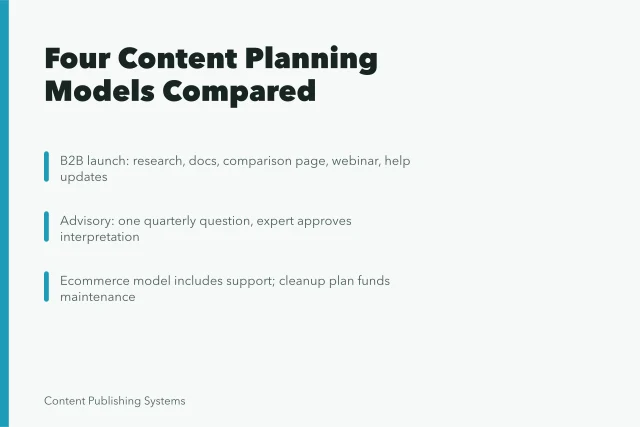
Four constructed content planning examples show what a realistic baseline and decision rule look like across a launch, an advisory firm, and a support program.
- Define the audience outcome, business outcome, baseline, measures, source, filters, observation window, limitations, and decision rule.
- Keep clicks, impressions, position, engagement, leads, and revenue definitions separate unless a valid method connects them.
- Set a review date or trigger for volatile claims, products, prices, laws, statistics, links, and markets.
- Assign a keep, improve, distribute, test, consolidate, redirect, archive, or retire decision after review.
Approve the item only when unresolved fields are either closed or explicitly accepted by the correct decision owner.
Checklist disposition record
| Status | Evidence to retain | Required action |
|---|---|---|
| Pass | Reviewer, scope, proof, date | Commit and monitor |
| Assigned | Gap, owner, due date, dependency | Resolve before release |
| Fail | Material defect or contradiction | Stop, correct, or cancel |
| Not applicable | Reason, scope, authorized reviewer | Recheck after change |
Record the gate result
The W3C Privacy Principles statement gives web-system designers shared privacy concepts and warns against shifting privacy work to individuals. Apply it to the checklist, then review the governing law and configuration.
The CISA software acquisition fact sheet covers development practice, supply-chain exposure, and vulnerability management. Add those acquisition questions to a checklist review without treating them as local approval.
For example, a recorded disposition reads: Assigned. Gap: missing model release. Owner: photo editor. Due date: 14 April. Dependency: rebooked shoot. The item waits until the release is filed.
Printable checklist
Copy this block into a document or a spreadsheet before the production meeting. One line per decision.
- Purpose in one sentence.
- First audience and its task.
- Claim, source, source date.
- Rights and permissions.
- Commercial disclosure.
- Hours per stage.
- Scarce roles and lead times booked.
- Name of the person who may stop publication.
- Format and channel chosen from the audience task.
- Access features planned.
- Baseline, measures, decision rule.
- Review date or trigger.
- Disposition with owner and date.
Common questions
Does a passed checklist guarantee on-time publication?
No. It shows the defined planning controls were examined. Estimates, dependencies, and platform changes can still change delivery.
Who should own the checklist?
Name one accountable planner and preserve each specialist's limited review scope and conditions rather than implying one approval covers everything.
When should the checklist be repeated?
Repeat it when claims, sources, rights, audience, format, owner, or risk changes materially.