Reviews
Part of Guide to Content Planning Before You Schedule a Single Deadline
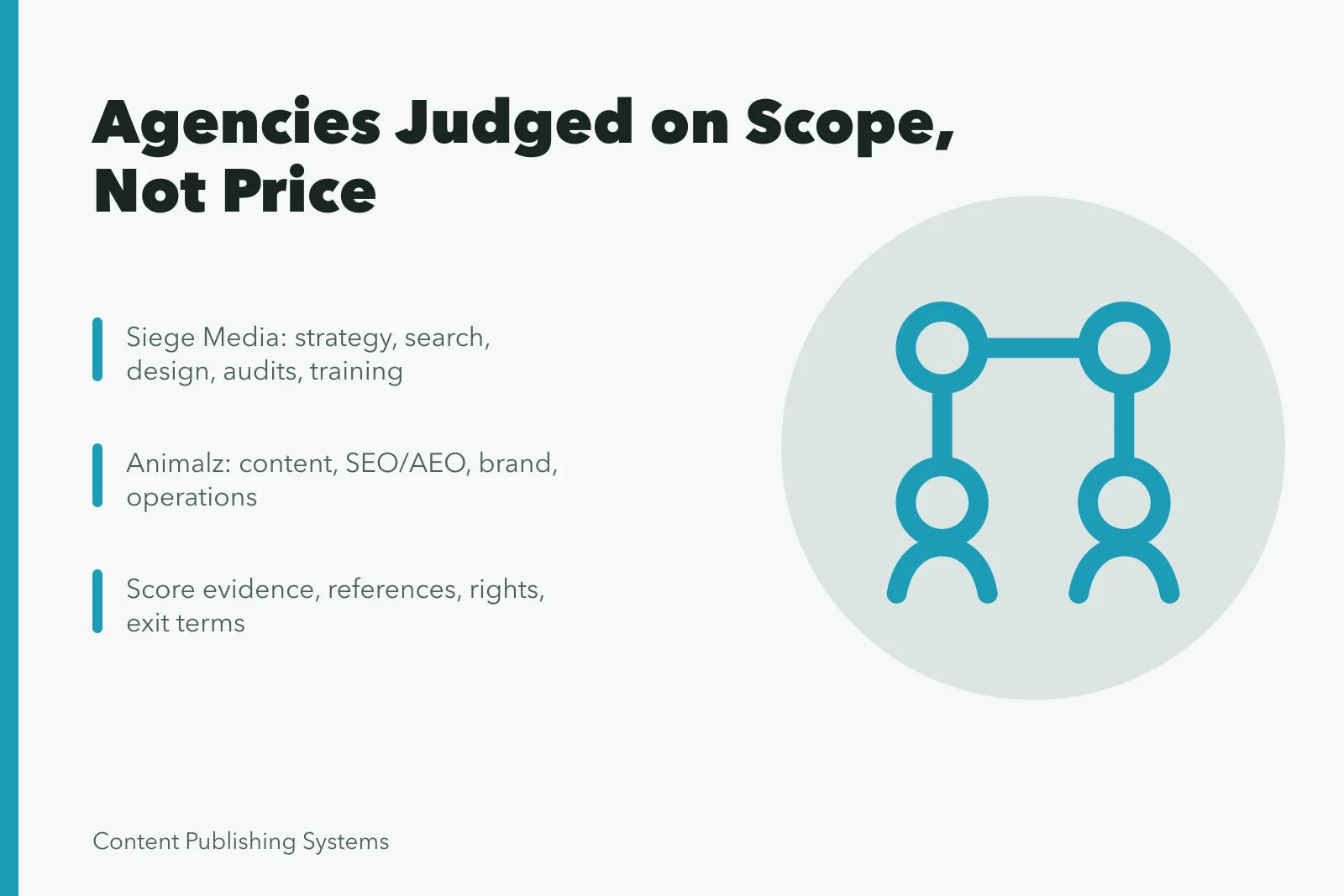
Content Planning Agencies: Judged on Scope, Not on Price
best content planning agencies for 2027 compares Siege Media and Animalz by documented scope, strategy, research, production, distribution, operations, and fit.
What to take away
- Two agencies are covered in fullSiege Media and Animalz. Both publish service scope a buyer can check. Neither publishes prices.
- Best for search-led content that needs design and promotion inside one proposal: Siege Media.
- Best for expert-led business-to-business work where editorial judgement carries the piece: Animalz.
- Rank the pair on scope, named contributors, evidence rules and exit terms. A low monthly fee does not make a mismatched scope cheaper.
- Nothing here is paid for or ranked by a vendor. Two documented models are enough to test a decision against.
Start with the guide to content planning to fix your own requirements before you invite quotes.
Why the shortlist stops at two
The shortlist names two agencies because both publish a detailed service scope and both take United States clients. Canada appears in some engagements. That is a boundary set by checkable evidence, not a claim that the market holds two firms.
Best fit
- Siege Media
- Search-led content with design and promotion
- Animalz
- Expert-led B2B and technology content
Publicly stated scope
- Siege Media
- Strategy, roadmaps, audits, competitive analysis, answer-engine work, UX assessment, content design, team training
- Animalz
- Production, brand, demand generation, SEO and AEO, product marketing, strategy, content operations, dashboards, publishing, conversion tracking, AI workflow work
First diligence question
- Siege Media
- Which named people would own the roadmap?
- Animalz
- How does the team acquire first-hand subject knowledge?
Scope decides fit, and fit is what a buyer is really comparing. Price only tells you what a scope costs.
Siege Media: scope built around search
Siege Media's content strategy page lists roadmaps, audits, competitive analysis, search and answer-engine work, UX assessment, content design and training for internal teams. It also names several agency roles involved in delivery. These are vendor descriptions, not an independent audit.
Consider Siege Media when organic discovery, content creation and promotion need to sit in one operating proposal. Ask for a sample planning system, the evidence rules writers follow, and a distribution plan with realistic reach.
Animalz: scope built around expertise
Animalz's content and SEO pages list production, brand and demand generation, SEO and AEO, product marketing, creative work, strategy, content operations, dashboards, publishing, conversion tracking and AI workflow implementation. Treat these as vendor-stated capabilities.
Animalz suits buyers whose audience needs expert-led material and editorial judgement. Test how the team handles product claims, documents sources, and transfers knowledge back to your own staff.
Example: the same brief sent to both
Write one brief and send it unchanged. A fair comparison starts there.
The same brief sent to both
- State the audience, the buying problem, the market, and whether Canada is in scope.
- Ask for the two people who would do the work, with samples they published.
- Request one planning artifact from a comparable client, with that client's permission.
- Set acceptance criteria for a paid pilot, and list what you keep at the end.
Scoring finalists on scope
Use the same criteria and the same reviewers for both replies. Score evidence above presentation.
- Audience understanding and first-hand research.
- Named contributors and their subject depth.
- Workflow, review points and approval load.
- Rights, portability and access to source records.
- Disclosure of sponsored or paid placements.
- Exit terms and knowledge transfer.
FTC guidance on native advertising sets the labeling standard paid placements must meet, so ask how sponsored content is marked. A content planning checklist keeps scores comparable between reviewers.
Comparable Selection Scoring Criteria
- Audience understanding
- Original research
- Strategic challenge
- Planning method
- Evidence and rights
- Contributor model
- Accessibility and disclosure
- Distribution and measurement
What these engagements cost
Neither agency publishes rates, minimum terms or engagement lengths on the pages reviewed. Request all three in writing, including what a paid discovery phase costs on its own.
A typical, unverified range for agencies of this class is roughly $8,000 to $25,000 per month. One-off audits and strategy projects usually sit below that. Treat the range as a prompt for questions rather than a price.
Evidence rules that apply to claims
The FTC advertising substantiation policy requires a reasonable basis for objective advertising claims before they are made. Apply that standard to any performance figure an agency publishes or sends to you.
The FTC guidance on reviews and endorsements covers fake feedback, selective requests, conditioned incentives and hidden relationships. Ask how any named client was chosen.
Weigh stated results against content planning benchmarks built from your own comparable work.