Operations
Part of Guide to Content Planning Before You Schedule a Single Deadline
The Content Planning Best Practices Worth Adopting First
content planning best practices for 2027 use one portfolio, controlled intake, reserved capacity, proof records, early access, distribution, upkeep, and decisions.
What to take away
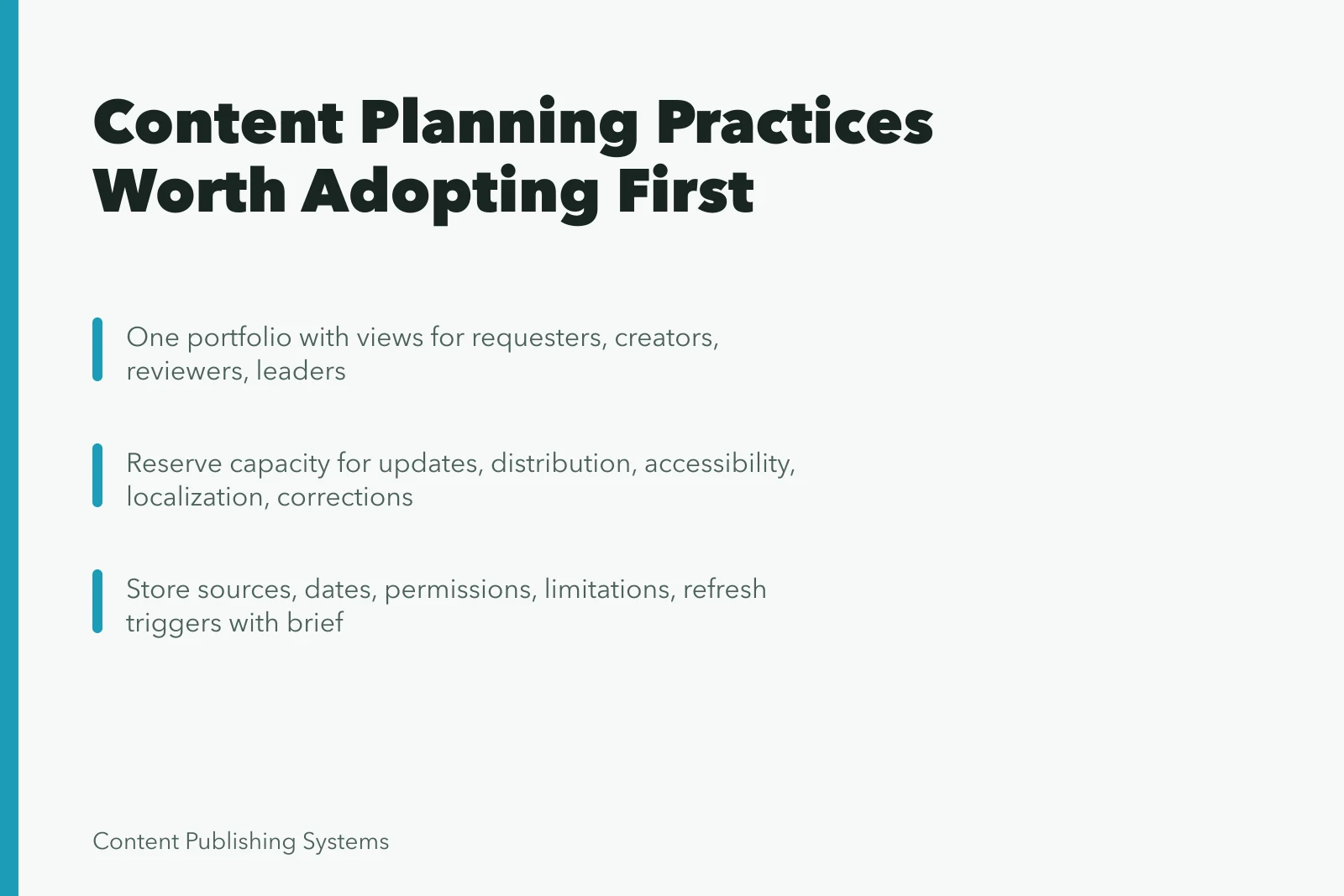
- Seven practices keep one governed portfolio while giving requesters, creators, reviewers, distributors, leaders, and analysts views suited to their decisions.
- Reserve capacity across new work, updates, distribution, experiments, accessibility, localization, corrections, consolidation, and retirement rather than filling every slot with drafts.
- Review decisions and assumptions, not only output counts, and preserve the evidence that caused work to start, stop, move, change, or retire.
Content planning best practices matter most when demand for work grows faster than expert and production capacity. The goal is not to freeze the calendar.
Use one portfolio, multiple views
Digital.gov's content-understanding test guide says testing should be part of writing and planning rather than a final afterthought, and describes paraphrase, usability, and comparative methods for different questions. Preserve the U.S. government context and plan a representative audience, consent, task, sample, owner, and decision before calling feedback evidence.
One Portfolio, Multiple Views
Executives
- View
- Filtered
- Source list
- Shared
- Reconcile
- No
Editorial staff
- View
- Filtered
- Source list
- Shared
- Reconcile
- No
Reviewers
- View
- Filtered
- Source list
- Shared
- Reconcile
- No
Regional teams
- View
- Filtered
- Source list
- Shared
- Reconcile
- No
Keep one controlled record for proposed, active, and published work. Cover measuring, updating, and retiring work, and give executives, editorial staff, reviewers, regional teams, and distribution partners their own filtered views, not separate source lists to reconcile by hand.
Comparing named platforms on exactly that view and permission need calls for a dedicated look at content planning tools. Assign an owner for definitions, permissions, archive rules, and record quality.
Make intake earn commitment
Ask every requester for audience, situation, evidence, timing, desired action, market, sponsor, and cost of delay. Route requests through eligibility and priority review. Publishing authority should remain explicit even when the requester is senior or the idea has visible search demand.
Reserve capacity by work type
Protect time for research, new production, updates, consolidation, distribution, localization, accessibility repair, experiments, and urgent corrections. Estimate the entire path through expert and compliance review. A growing queue is not a reason to omit the slow work that makes claims dependable.
Give each asset a proof record
Store primary sources, source dates, method, contributor, permissions, commercial influence, limitations, and refresh triggers with the brief. Google's people-first guidance emphasizes clarity about who created content, how it was made, and why. Skipping this step is one of the recurring content planning mistakes worth checking against directly.
Plan access and disclosure early
W3C's planning and managing accessibility framework organizes work across initiation, planning, implementation, and sustainment, including objectives, policy, resources, skills, tools, early evaluation, monitoring, and user feedback. The activities are iterative, and the framework does not certify a completed asset or organization.
Include headings, meaningful links, text alternatives, captions, transcripts, readable instructions, accessible formats, and an accountable checker at intake. Mark sponsored, affiliate, partner, and customer-influenced work. FTC and W3C guidance should shape the workflow, with qualified local interpretation when required.
Commit distribution and maintenance
Name the first audience, channel, owner, adaptation, timing, cost, permission basis, and follow-up before production. Set a review date or trigger for claims, products, prices, laws, links, and markets. New output should compete transparently with the upkeep of existing useful material.
Review decisions, not vanity
Track flow, quality, discovery, audience progress, and relevant business contribution with consistent definitions and baselines. Search Console cautions that average position and aggregated data need context. At review, decide to continue, improve, distribute, test, consolidate, or retire, the same closing move that ends the 8-step content planning process.
Best-practice ownership map
| Practice | Evidence to retain | Failure signal |
|---|---|---|
| Portfolio | One record with role-based views | Conflicting calendars |
| Intake | Need, evidence, urgency, requester | Request equals commitment |
| Capacity | Work class, estimate, dependency | Drafts fill every slot |
| Proof and access | Claim, right, format, test | Review arrives late |
| Learning | Baseline, decision, change history | Activity without action |
Assign the practice
The NIST Privacy Framework starting guide outlines a voluntary process for identifying and managing privacy risk. Use it to assign data and response owners for content planning best practices; it is not legal clearance.
The CISA business-system logging guidance explains how event records support security review. Preserve appropriate content planning best practices access, change, failure, and correction records without claiming that logging validates a metric.
Common questions
Should every team use one planning view?
No. Use one governed source record with different filtered views for leadership, requesters, production, review, distribution, analytics, and maintenance.
How much capacity should maintenance receive?
Base the range on library size, evidence age, defect history, obligations, traffic, dependencies, risk, and update cost. Revisit it when exposure changes.
What makes a planning practice repeatable?
Give it a trigger, owner, input, method, evidence record, decision right, exception path, stop condition, correction route, and review cadence.