Rules
Part of Guide to Content Planning Before You Schedule a Single Deadline
Setting Content Planning Benchmarks: Built to Survive a Bad Quarter
content planning benchmarks for 2027 compare portfolio balance, flow, capacity accuracy, quality, discovery, use, audience progress, business value, and upkeep.
What to take away
- Build internal benchmarks from stable workflow states, comparable work classes, a defined sample, a time window, and known collection limits before seeking external averages.
- Separate portfolio balance, flow, capacity accuracy, quality, discovery, use, audience progress, business contribution, and maintenance exposure.
- Use decision ranges rather than one target, and investigate changes in scope, staffing, evidence, risk, season, channel, data, or definition before judging performance.
Content planning benchmarks should help a team decide, not supply a decorative industry average. There is no universal healthy publishing frequency, traffic level, conversion rate, cycle time, or content volume.
Benchmark portfolio balance
Track planned and completed effort across new work, research, updates, consolidation, localization, accessibility repair, distribution, experiments, and retirement. Compare the mix with strategic priorities and maintenance exposure. A rising title count can coexist with worsening evidence quality or an unmanaged older library.
Portfolio Mix vs Priorities
Planned effort
- New work
- high
- Research
- medium
- Updates
- high
- Consolidation
- low
- Localization
- medium
- Accessibility repair
- low
Completed effort
- New work
- medium
- Research
- low
- Updates
- high
- Consolidation
- low
- Localization
- low
- Accessibility repair
- low
Strategic priority
- New work
- high
- Research
- medium
- Updates
- medium
- Consolidation
- medium
- Localization
- high
- Accessibility repair
- high
Benchmark flow
Measure cycle time by work type and stage, work in progress, blocked time, revision loops, missed dependencies, and percent completed as committed. Use medians and ranges when a few complex items distort averages.
Flow Metrics to Track
- Cycle time by work type
- Work in progress
- Blocked time
- Revision loops
- Missed dependencies
- Percent completed as committed
Benchmark capacity accuracy
Compare estimated with actual effort by role for research, expert review, legal or compliance, design, localization, publishing, and distribution. Record why estimates changed. The aim is better commitments, not pressure to remove necessary verification or accessibility work, the same capacity step covered inside the 8-step content planning process.
Estimated vs Actual Effort by Role
Estimated effort
- Research
- medium
- Expert review
- medium
- Legal or compliance
- low
- Design
- medium
- Localization
- low
- Publishing
- medium
- Distribution
- low
Actual effort
- Research
- high
- Expert review
- high
- Legal or compliance
- medium
- Design
- medium
- Localization
- high
- Publishing
- medium
- Distribution
- medium
Benchmark quality
Track factual corrections, broken evidence, rights or disclosure issues, accessibility defects, rejected drafts, post-publication incidents, and refresh compliance. Pair counts with severity and opportunity for detection. A low defect count can mean strong quality or weak checking, so preserve the audit method.
Benchmark discovery and use
Google Search Central's Search Console and Analytics comparison guide distinguishes Search Console as the source for Google Search performance and Google Analytics as the source for configured behavior inside the site. Clicks and sessions can differ because the systems use different attribution, canonical URL, and bot treatments. Compare trends only after preserving each system's population, definitions, and filters.
Search Console defines impressions, clicks, click-through rate, and average position, while warning that aggregation and position need context. Compare consistent cohorts, filters, sources, and windows.
Benchmark audience and business outcomes
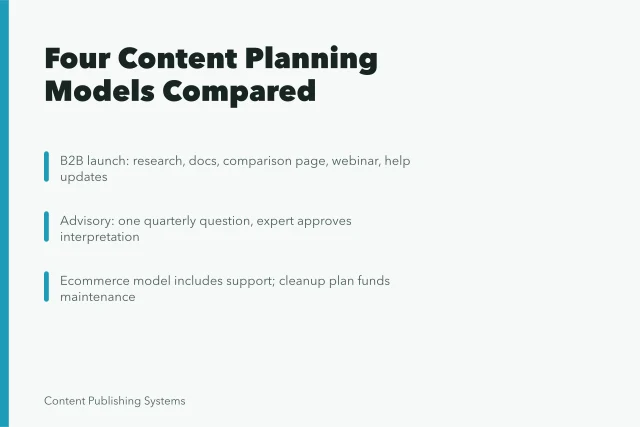
Select task completion, qualified actions, sales usefulness, support resolution, activation, retention, or another relevant outcome. Document baseline, population, attribution limits, other contributors, and decision threshold. A content touch may contribute without being the sole cause. Four constructed content planning examples show what a realistic outcome baseline looks like across a launch, an advisory firm, and a support program.
Use a decision range
Google Analytics' GA4 configuration-limits page documents per-property limits for configured items, reporting exports, retention, and sampled or ad hoc queries, with different limits for Analytics 360. Verify the current property, plan, date range, sampling state, retention, and export before treating a dashboard count as complete.
For each benchmark, set expected range, warning range, review date, owner, and action. Compare like with like over several periods before changing the operating system.
Planning benchmark definition record
| Benchmark class | Example measure | Required context |
|---|---|---|
| Portfolio | New, update, distribute, retire mix | Strategy and work classes |
| Flow | Lead time and blocked days | State definitions |
| Capacity | Estimated versus actual effort | Role and scope changes |
| Quality | Correction and access defects | Severity and sample |
| Outcome | Task progress or business decision | Population and attribution |
Make the comparison reproducible
The GAO evaluation design guide connects evaluation questions with evidence needs and design choices. Apply that discipline to content planning benchmarks; federal evaluation guidance does not make a local marketing result causal or transferable.
The NIST experimental design selection guidance begins design choice with the objective and practical constraints. It supports separating content planning benchmarks reporting from controlled effect estimates, not turning observation into causation. That same discipline is what a content planning checklist is meant to enforce before a single benchmark gets measured.
Common questions
What is a good content planning benchmark?
A useful benchmark is comparable, defined, decision-linked, and honest about collection limits. The right range depends on work type, audience, evidence, quality, capacity, channel, market, and risk.
Should an external report set the target?
No. Use it as context after checking sample, market, dates, definitions, distribution, sponsors, exclusions, and comparability with the team's own process.
How often should benchmarks be reviewed?
Review them on a stable cadence and after changes to strategy, workflow, staffing, tooling, definitions, data collection, work mix, audience behavior, or risk.