Costs
Part of Starting a Content Marketing Strategy: Begin With the Business Constraint
Serving a Real Audience Problem: The Core of Content Marketing Strategy
content marketing strategy best practices for 2027 connect audience problems, evidence, focused architecture, accessible distribution, metrics, and upkeep.
What to take away
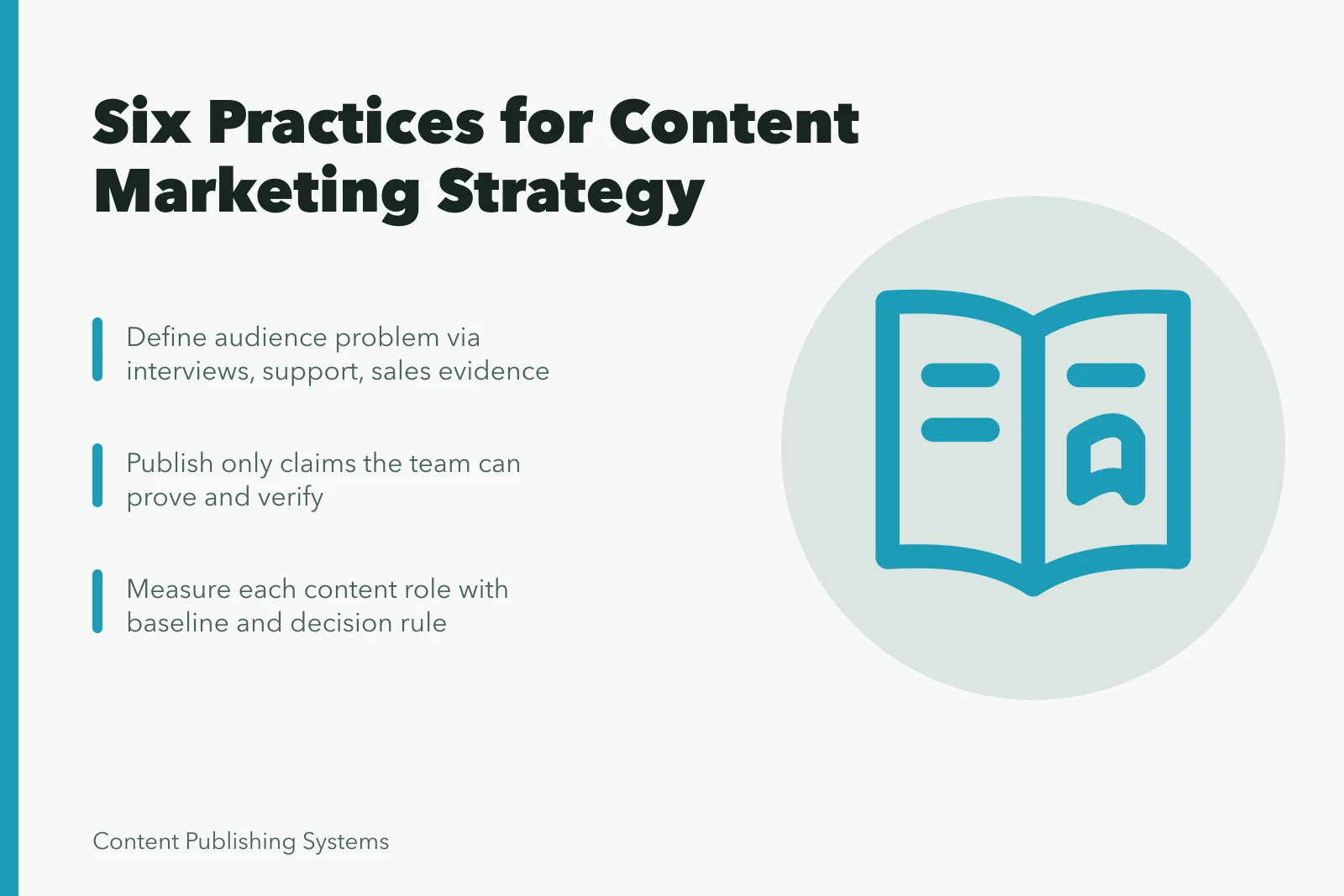
- Six practices connect a verified audience problem to defensible evidence, a focused architecture, accessible distribution, decision-ready measurement, and planned upkeep.
- Publish only what the team can support with appropriate expertise, sources, methods, rights, disclosure, review, correction, and ownership.
- Measure each content role with a defined baseline and decision rule, then maintain, consolidate, replace, annotate, archive, or retire material as evidence changes.
Content marketing strategy best practices are operating disciplines, not guarantees of traffic or revenue. Apply them according to the audience, business model, evidence, market, risk, capacity, and channel.
Serve a known audience problem
Define the Audience Problem
- Use interviews, support and sales evidence
- Use permitted behavior data and search language
- Study communities and direct observation
- Define situation, task, stakes, alternatives
- Define barriers and desired progress
- Write a mission narrow enough to reject topics
Start with an observed problem, not a persona. Pull language from support tickets, sales call notes, site search logs, Reddit threads, and Google Trends. Group repeated phrases into problem statements. Example: 'I cannot tell which pay period a correction applies to.'
Validate in three steps. One: count how often the problem appears in at least two sources over 30 days. Two: use Google Forms to screen and interview five to eight people who have the problem. Three: test a small page or post and check whether the target action moves.
If fewer than three people confirm the problem, stop. If the problem is real but the team cannot support it with evidence, rights, review, or upkeep, do not publish.
Publish what the team can prove
Google's SEO Starter Guide recommends readable, organized, unique, current, helpful, reliable, people-first content. Treat that as Google Search guidance rather than a guaranteed ranking formula. The publisher must still verify claims, rights, audience fit, accessibility, distribution, conversion design, and business value independently.
Publish What You Can Prove
- Readable, organized, unique, current content
- Helpful, reliable, people-first content
- First-hand tests and accountable expertise
- Original analysis and transparent methods
- Name authors and reviewers
- Cite sources close to claims
- Preserve an evidence record
Build from first-hand tests, accountable expertise, original analysis, transparent methods, useful examples, and qualified uncertainty. Name authors and reviewers where readers expect them. Cite sources close to claims and preserve an evidence record. Explain who created the content, how it was produced, and why.
Design a focused architecture
Map existing content, organize clusters around audience tasks and decisions. Give each page a distinct purpose, overlap rule, next action, owner, and maintenance trigger, and match format to the job.
Use descriptive titles, crawlable links, logical structure, and clear text so people and search systems understand material. In content marketing strategy tools, compare Search Console impressions and average position for the cluster's target queries against GA4 organic entrances to cluster pages.
Decision rule: if impressions rise but organic entrances do not move after 60 days, the new structure did not change discovery.
Plan distribution and access
Specify the initial audience, channel, message, adaptation, permission, collaborator, owner, budget, and follow-up before drafting. Build informative titles, semantic headings, meaningful links, text alternatives, captions, transcripts, clear instructions, and readable language into briefs and templates. Confirm the same fields again before any wider distribution push, not only before the first draft.
Measure to make a decision
Separate availability, discovery, consumption, comprehension, action; separate qualification, sales use, retention, service outcomes. Define each measure, source, population, window, and decision rule. Preserve platform limitations; use experiments for causal questions.
For example, a typical baseline for a support article is 120 organic sessions per month and a 3 percent help-centre task completion rate over 90 days. A typical target is 150 to 180 sessions and 5 percent completion. Decision rule: if after 90 days the page stays below 100 sessions and 2 percent completion, consolidate it or retire it.
Review quality defects, update cost, stale-content exposure alongside public performance; compare them against internal ranges, not an imported average, as in content marketing strategy benchmarks.
Maintain what earns trust
Nottinghamshire County Council's content-design guide frames content design as planning, writing, and managing material so it works for users and meets organizational aims. Its local-government guidance includes user needs, deciding what should and should not be published, structure, maintenance, audits, and unpublishing at the end of life.
For a US content team, the method transfers even though the examples are UK local-government: user needs, audits, and unpublishing are the same tasks.
Assign owner, evidence date, rights, and next review. Update when facts or audience needs change. Consolidate duplication and retire material that cannot be maintained. Do not change a date solely to imply freshness.
Best-practice control map
| Practice | Required evidence | Failure signal |
|---|---|---|
| Audience | Observed problem and language | Persona without research |
| Evidence | Claim, source, expert, limit | Unsupported certainty |
| Architecture | Distinct page role and boundary | Overlapping intent |
| Distribution | Behavior, access, permission, owner | Publish and hope |
| Learning | Baseline, metric, decision rule | Dashboard without action |
| Upkeep | Trigger, owner, correction, retirement | Stale ownerless work |
Worked example: a payroll software team supports US small businesses. Audience: support tickets show owners cannot tell which pay period a correction applies to. Evidence: 30 ticket tags and five interviews. Architecture: one page per correction type, no overlap.
Distribution: link from the in-product help panel and the monthly newsletter. Learning: baseline 90 organic sessions; target 120; decision rule after 60 days. Upkeep: owner and quarterly review.
Assign the practice
The NIST Privacy Framework starting guide outlines a voluntary process for identifying and managing privacy risk. For a US content team, use it to assign data and response owners for content marketing strategy best practices; it is not legal clearance.
The CISA business-system logging guidance explains how event records support security review. For a US content team, preserve access, change, failure, and correction records without claiming that logging validates a metric.
Common questions
How many best practices should a team adopt at once?
Start with all six as control areas, but narrow implementation to the smallest release the team can support. A fast cadence does not excuse missing evidence, access, distribution, measurement, or upkeep.
Are SEO best practices the whole strategy?
No. Search may support discovery. Strategy also covers audience value, business purpose, evidence, formats, nonsearch channels, operations, rights, accessibility, measurement, and lifecycle.
What makes a practice repeatable?
Give it a trigger, owner, input, method, evidence record, review scope, exception path, stop condition, correction route, and maintenance schedule.