Costs
How to budget a modern roadside design case study
Roadside case study budget notes for 2027 help U.S. writers scope research, permissions, records, interviews, editing, disclosures, and later content updates.
A case-study budget should show the work required to produce a credible record. It should not invent a project's financial result or imply that every example has the same research cost. This guide helps a publisher scope content work, not price construction, professional services, or public approvals.
What to take away
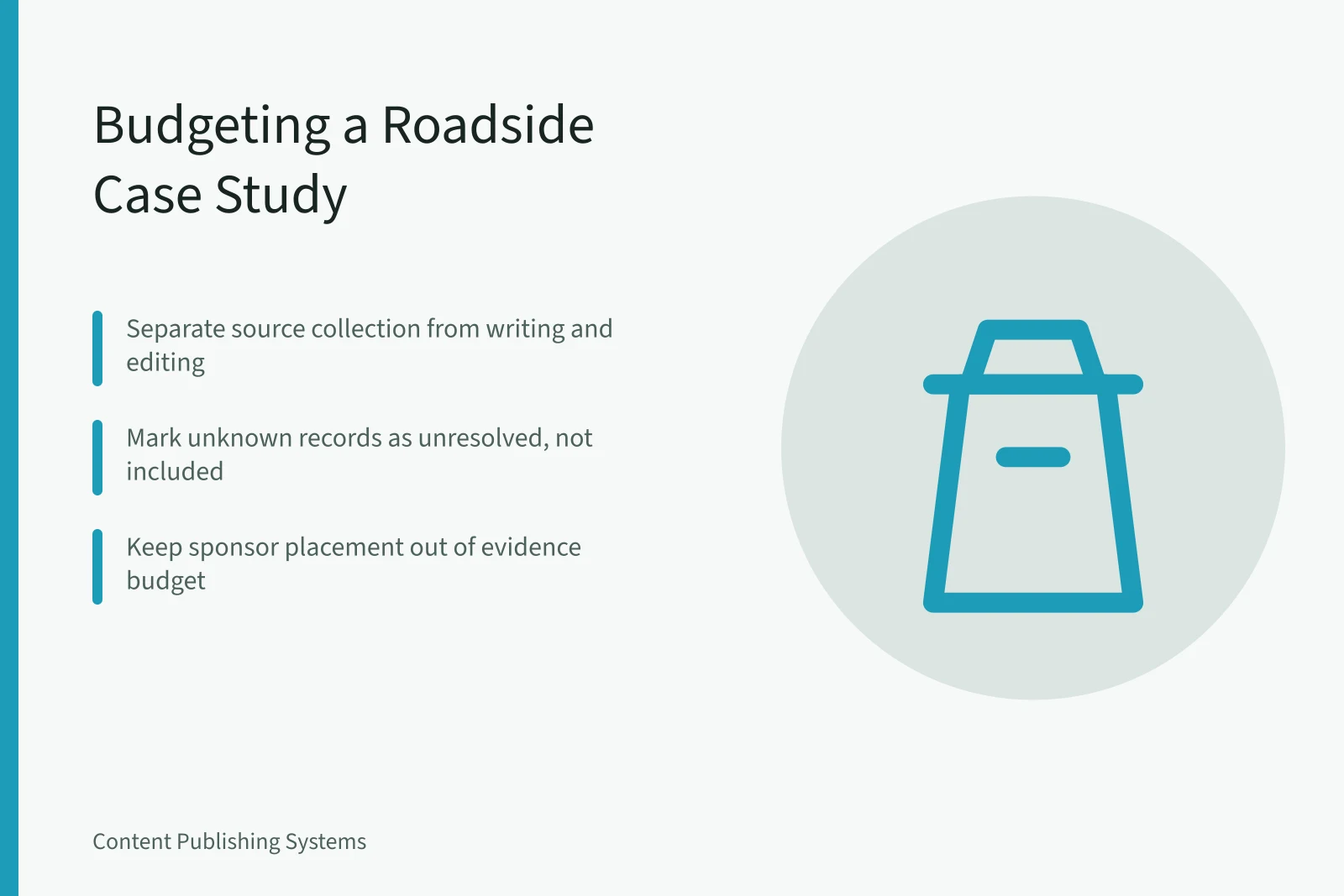
- Separate source collection from writing and editing.
- Budget time for permissions, captions, disclosures, and corrections.
- Mark unknown records as unresolved instead of treating them as included.
- Keep a sponsor placement separate from evidence collection.
Create research work categories
| Category | What to scope |
|---|---|
| Brief | Question, time period, place, role map, and intended audience |
| Source work | Original files, public records, source dates, and limitation notes |
| Interviews | Outreach, consent, attribution, fact checking, and approved quotations |
| Media | License or source credit, caption, alt text, and contextual limitation |
| Writing | Outline, draft, evidence check, edits, and disclosure copy |
| Updates | Link review, correction handling, and a future review date |
An Environmental Protection Agency evaluation of case-study findings explains that intentional case selection can yield rich detail. It also carries limits that matter when findings are interpreted.

Its New England evaluation report is not a budget model for an article. It supports one limited editorial practice: allow time to document selection criteria, evidence limits, and the difference between a case example and a universal conclusion.
Identify assumptions before estimating effort
Write down whether source files are available, an interviewee has approved quotation, images can be published, and a sponsor relationship must be disclosed. If any item is unknown, treat it as a decision point.
Do not quote a provisional number as though it includes permissions, archive work, legal review, or technical verification that has not been scoped.
Price the production steps separately
Content estimates separate countable work from access-dependent work. Source retrieval, interview scheduling, transcription review, image permissions, and fact checks can each take different time, while editing and update work may take different time.
A low writing fee can be reasonable for a short, well-documented profile, but it is not comparable with a source-based study that begins with incomplete records.
The National Archives guidance on agency recordkeeping explains federal responsibilities for records that document activities and decisions. It does not provide private editorial rates. It supports budgeting time for a source register, decision notes, and a way to identify which version of a record informed the final draft.
Use an assumptions table before requesting or approving a content budget.
| Assumption | Budget effect if it changes |
|---|---|
| Primary records are already available | Less time for retrieval and verification |
| One spokesperson can answer factual questions | Less coordination and review time |
| Existing media has a verified source page | Less time for permission or replacement media |
| The article needs a commercial disclosure | More time for approved labeling and review |
| The subject may change after publication | More time reserved for dated updates |
Keep paid placement out of the evidence budget
An agency, provider, or local business may pay for a clearly marked profile or placement. That payment does not fund a factual conclusion. Preserve a separate disclosure record and do not allow a commercial relationship to decide what evidence an article reports or omits.
The Federal Trade Commission's endorsement guides address endorsements and testimonials in advertising. They do not tell a publisher how to set a research budget. They are relevant because paid relationships and testimonials can require careful disclosure and review rather than being folded into a general writing fee.
Reserve time for a defensible handoff
The final deliverable should include more than the published page. Budget time to assemble the source register, approved quote record, image credit information, disclosure language, publication date, and correction contact. That handoff lets a later editor inspect a claim without reconstructing the work from inbox messages.
For a case study that relies on a documented historic feature, the National Park Service documentation standards and guidelines show the value of identifying evidence and its scope. They do not prescribe a commercial article package. Their relevant principle is limited: a description should remain tied to the record that supports it.
Budget for maintenance of the article
Case studies often become inaccurate because a source moves, a role changes, or a later event is added without context. Include a simple update process: who watches for corrections, which links are checked, what date triggers review, and how a corrected statement will retain its history.
Common questions
What is the first research cost to identify?
The records needed to answer the stated question, including whether they are public, available, and usable with accurate attribution.
Should a sponsor pay for the case-study conclusion?
No. Sponsorship should be disclosed and kept separate from the evidence and editorial conclusion.
Why budget for updates?
Sources, roles, and published information can change. An update plan prevents a dated article from silently becoming inaccurate.