Rules
Part of Starting a Content Marketing Strategy: Begin With the Business Constraint
Saramin vs Wingtra: What Two Content Marketing Strategy Cases Prove
content marketing strategy case studies for 2027 review Saramin with Google Search and Wingtra with HubSpot by workflow, outcomes, evidence, and transfer limits.
What to take away
- This unpaid, nonranking review covers two named vendor-published stories; neither is an independent audit, controlled experiment, universal benchmark, or promised result.
- Saramin's story centers on technical Search changes and reported organic outcomes, while Wingtra's page presents a Marketing Hub Professional content-marketing relationship.
- Transfer a testable principle only after recording the publisher, subject, relationship, baseline, intervention, content role, metric source, other changes, limits, and unanswered questions.
Content marketing strategy case studies can reveal useful operating questions, but vendor-published stories are marketing, not independent audits. This unpaid, nonranking review was checked in August 2026. Treat reported metrics as claims from a stated context, not universal benchmarks, causal proof, or promised outcomes. Verify current pages and methods before citing or adapting them.
Saramin's Google Search case
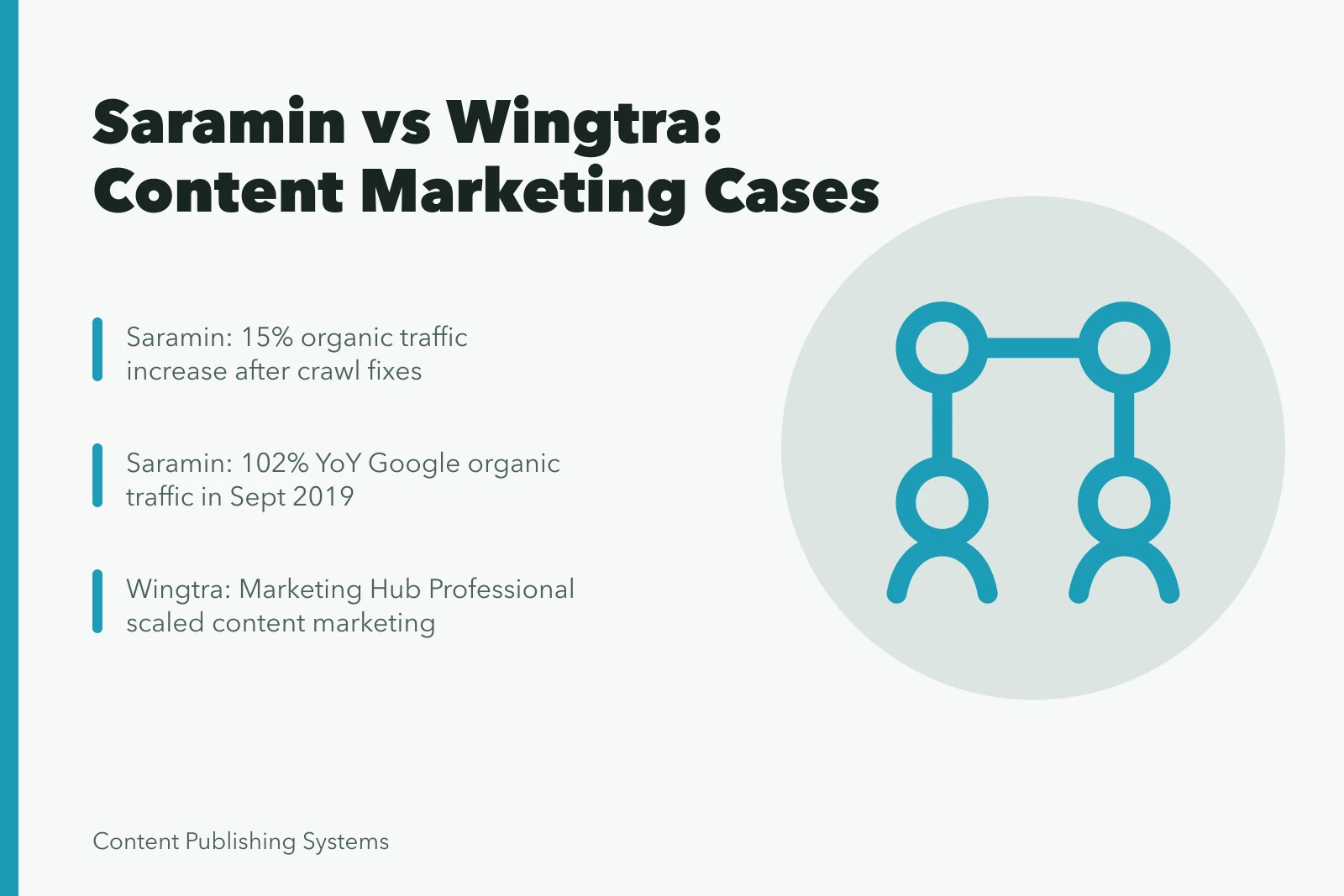
Google's Saramin SEO case study reports a 15 percent organic-traffic increase after early crawl and indexing work. That work preceded a 102 percent year-over-year increase in Google Search organic traffic during the September 2019 hiring season.
Saramin SEO Work and Results
- Early workSearch Console, crawl-error fixes
- Alsocanonical URLs, duplicate removal, structured data
- Sept 2019102% YoY organic traffic rise
- After early work15% organic-traffic increase
- Caveatsubject-reported, not controlled proof
The case study also notes subject-reported signup and conversion changes. The sequence is not controlled proof that one intervention caused every result.
Google's Saramin story reports work that began with Search Console, crawl-error fixes, and removal of unnecessary keyword meta tags. It also used canonical URLs, duplicate-content removal, and applicable structured data.
The page does not establish a controlled causal estimate or prove the same technical and content mix will transfer to another market. These constructed teaching models in content marketing strategy examples carry no comparable customer data, so they are labeled models rather than case studies.
Wingtra's HubSpot content case
HubSpot's Wingtra customer story identifies Wingtra as using Marketing Hub Professional to scale content marketing. Because HubSpot publishes a story about its own customer and product, treat the page as vendor evidence. Verify the current story, customer relationship, plan, market, baseline, time window, metric definitions, other changes, implementation support, and independent business records before adapting a practice.
Verify the Wingtra Vendor Story
- Current story and customer relationship
- Plan, market, baseline, time window
- Metric definitions and other changes
- Implementation support and business records
- Planning, production, distribution, data
- Staffing and lead handling
- Separate platform results from sales evidence
This is a product-vendor account of a named customer's workflow, not an independent evaluation, so inspect changes in planning, production, distribution, and data. Then check staffing and lead handling.
Separate platform-attributed results from independently reconciled sales or financial evidence before proposing a transfer test, since Wingtra appears throughout as a HubSpot customer, not an outside party.
Build a transfer test
For each selected story, log publisher, subject, relationship, audience, problem, baseline, intervention, content role, channels, operations, metric, source, attribution, limitation, other changes, and unanswered questions. Extract a testable principle, not a result target. Content marketing strategy best practices sets the same evidence and ownership standard a transferred principle has to meet before it is published.
Pilot it with your own audience evidence, baseline, quality controls, costs, and decision rule. Do not copy quotes, logos, screenshots, or claims without permission and context.
Two-case transfer test
Documented emphasis
- Saramin with Google
- Search and technical improvements
- Wingtra with HubSpot
- Vendor-described content scaling
- Either
- Publisher-selected customer account
Transfer question
- Saramin with Google
- Which changes match this site's defects?
- Wingtra with HubSpot
- Which workflow changed beyond software?
- Either
- What evidence is missing or dependent?
Audit the published evidence
The FTC advertising substantiation policy requires a reasonable basis before objective advertising claims are disseminated. Apply that U.S. rule to public content marketing strategy case studies performance statements.
The FTC guidance for marketers using reviews warns about fake feedback, selective requests, hidden relationships, and paid rankings. Apply those U.S. integrity checks when case studies content names providers.
Common questions
Do these case studies prove the tools caused growth?
No. They describe changes and reported outcomes in selected customer contexts. Neither page supplies a randomized control or enough evidence to exclude all other causes.
Why include vendor case studies?
They can expose operating hypotheses, implementation details, and questions worth testing. Label the relationship and separate documented facts, customer reports, vendor framing, inference, and missing evidence.
What should a transfer pilot preserve?
Preserve your own baseline, audience, intervention, content role, quality controls, cost, measurement window, decision rule, stop conditions, and record of other changes.