Strategy
Content Publishing Systems for Regulated Industries: What Changes
A guide to content publishing systems for regulated industries: audit trails, approval gates, versioned sign-off, retention rules, and governance controls.
What to take away
- Regulated publishing needs four system controls before launch: immutable audit trails, role-based approval gates, versioned sign-off, and retention rules.
- The workflow must encode external rules, including FTC disclosure, CASL consent, PIPEDA privacy, and Quebec language requirements.
- Approval gates should map to named roles and backups, not informal seniority.
- Evidence must be exportable as a timestamped record that shows who approved which version.
- Platform choice matters less than configured controls, but portability and syndication can change the decision.
Rule Set Mapping Before Tool Selection
Content publishing systems for regulated industries begin with a map of obligations. Each market, product, and audience brings different rules. A native advertising audit often starts with the FTC guidance on native advertising and disclosure requirements. Email and SMS campaigns need consent records that match CASL.
Privacy teams may require a record of consent and purpose under PIPEDA. These rules define what the CMS must capture. The system then turns policy into a gate.
Configure Immutable Audit Trails and Versioned Sign-Off
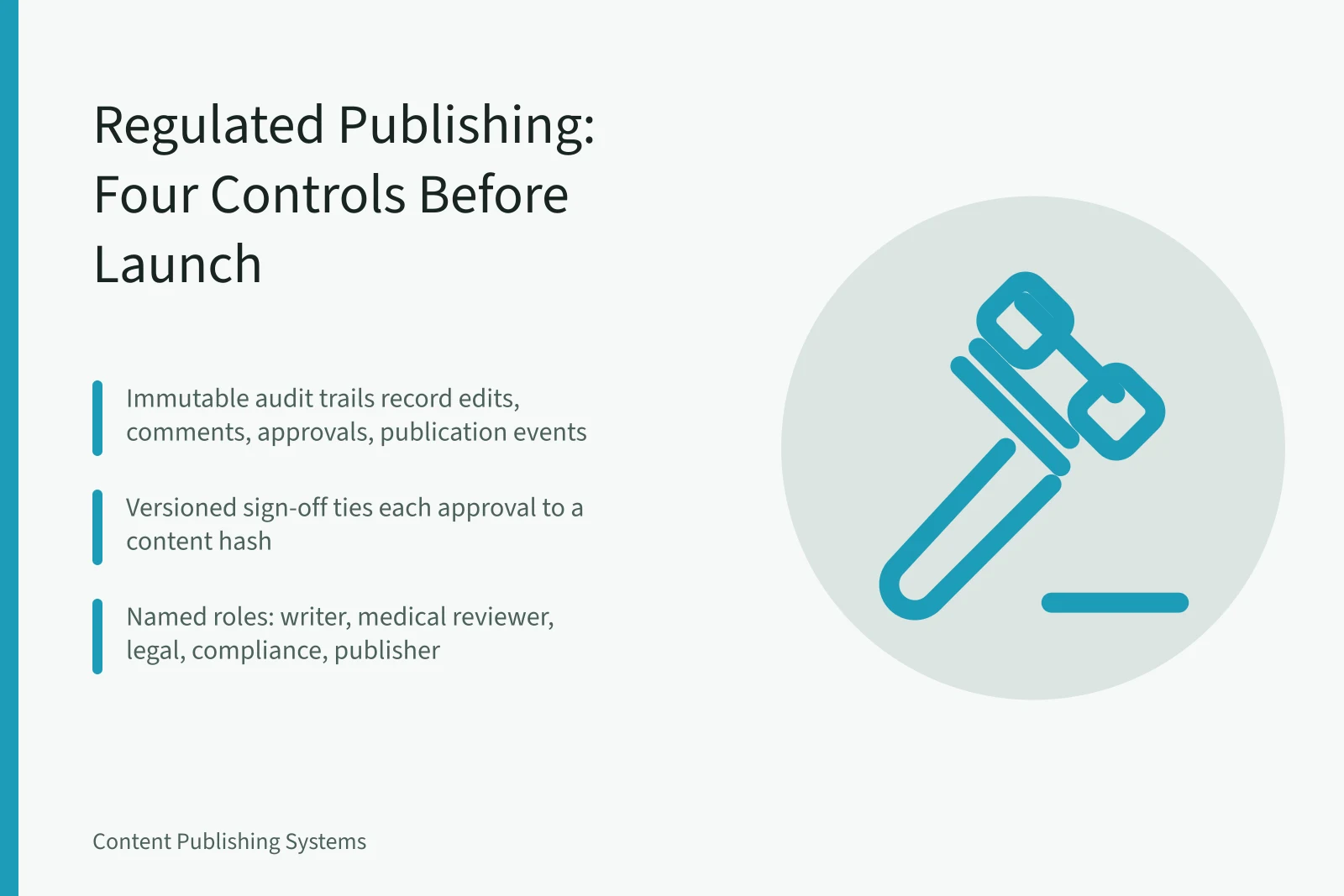
An audit trail must record creation, edits, comments, approvals, and publication events. It must be immutable, so no admin can alter history. Versioned sign-off means each approval attaches to a specific version, not a live page. Use content hashes or version IDs. Then a later edit cannot inherit an earlier approval. This distinction supports a defensible regulated content review process.
Regulated Publishing Controls
Control
- Immutable audit trail
- User, action, timestamp, IP, version
- Role-based gate
- Approver role, decision, comment
- Versioned sign-off
- Asset hash and approved version
- Retention rule
- Retention period, legal hold, deletion date
What it stores
- Immutable audit trail
- Unaltered history for regulators
- Role-based gate
- Prevents self-approval of claims
- Versioned sign-off
- Stops unchecked post-approval edits
- Retention rule
- Matches privacy limits and holds
Why regulated teams need it
- Immutable audit trail
- Role-based gate
- Versioned sign-off
- Retention rule
Audit Trails and Versioned Sign-Off
| Control | What it stores | Why regulated teams need it |
|---|---|---|
| Immutable audit trail | User, action, timestamp, IP, asset version | Shows an unaltered history for regulators and auditors |
| Role-based gate | Approver role, decision, comment | Prevents a writer from approving their own claim |
| Versioned sign-off | Asset hash and approved version | Stops a post-approval edit from going live unchecked |
| Retention rule | Retention period, legal hold flag, deletion date | Matches privacy limits and litigation holds |
Build Role-Based Approval Gates
CMS approval workflows for regulated industries need named roles. A writer, medical reviewer, legal counsel, compliance officer, and publisher may each hold a gate. Separation of duties stops one person from drafting and approving a sensitive claim. Escalation rules cover absences and urgent updates. Content publishing workflow compliance depends on those gates.
The regulated content review process should also record rejected versions and reasons. That record helps training and audits.
Set Retention Rules and Legal Holds
Retention rules decide how long each asset, approval, and comment stays in the system. Privacy law may require deletion after a set period, while sector rules may require a legal hold. The CMS should separate content retention from audit retention.
A published page may be deleted, but the approval record may need to survive. Export tools should produce a readable evidence package. Then legal and compliance teams can respond without engineering help.
If the system cannot show who approved which version, the workflow is not defensible.
Example: A Regulated Launch Workflow
A health product page needs a claim review, legal sign-off, and a privacy check. The workflow might run as follows.
Regulated Launch Workflow
- Writer drafts page and tags claims
- Medical reviewer approves or rejects claims
- Legal counsel records versioned sign-off
- Compliance officer checks CASL and PIPEDA
- Publisher schedules approved version and locks asset
After launch, the audit trail must show every step. A later edit opens a new version and a new approval cycle. This pattern applies to financial, energy, and health content.
Pre-Launch Content Publishing Governance Checklist
Pre-Launch Governance Checklist
- Audit trail is immutable and exportable
- Every gate names primary approver and backup
- Versioned sign-off stores the asset hash
- Retention rules match privacy limits and holds
- Evidence export works without engineering support
Connections to Wider Content Operations
The controls above do not replace a content strategy. Before configuring workflows, align scope with content marketing strategy for 2027, which connects audience needs, business goals, evidence, and governance.
Platform choice also matters. If portability and syndication drive your decision, compare headless CMS for content teams, which weighs headless against WordPress and custom builds on cost and workflow.
Teams in Alberta can extend this checklist with Calgary content marketing, which covers AER disclosure and Competition Bureau rules.
Agencies in bilingual markets can adapt these controls using Toronto content publishing systems, which blend bilingual editorial calendars, translation handoffs and approval chains.