Careers
Part of Starting a Content Marketing Strategy: Begin With the Business Constraint
Evidence, Formats and AI: Where Content Marketing Strategy Is Heading
Visible expertise, reusable evidence, accessible formats, governed AI help and planned upkeep are the content marketing strategy trends worth testing.
What to take away
- Treat each direction below as a hypothesis to test on a limited content set, not a forecast.
- Every pilot needs a named owner, a baseline, a stop condition and a review date before it starts.
- Google's AI content guide and spam policies are Search guidance, not evidence that a workflow is accurate.
- NIST's AI RMF and the W3C Privacy Principles are voluntary references, not checklists.
- Keep a change only when it improves a decision without weakening accuracy, rights, access or privacy.
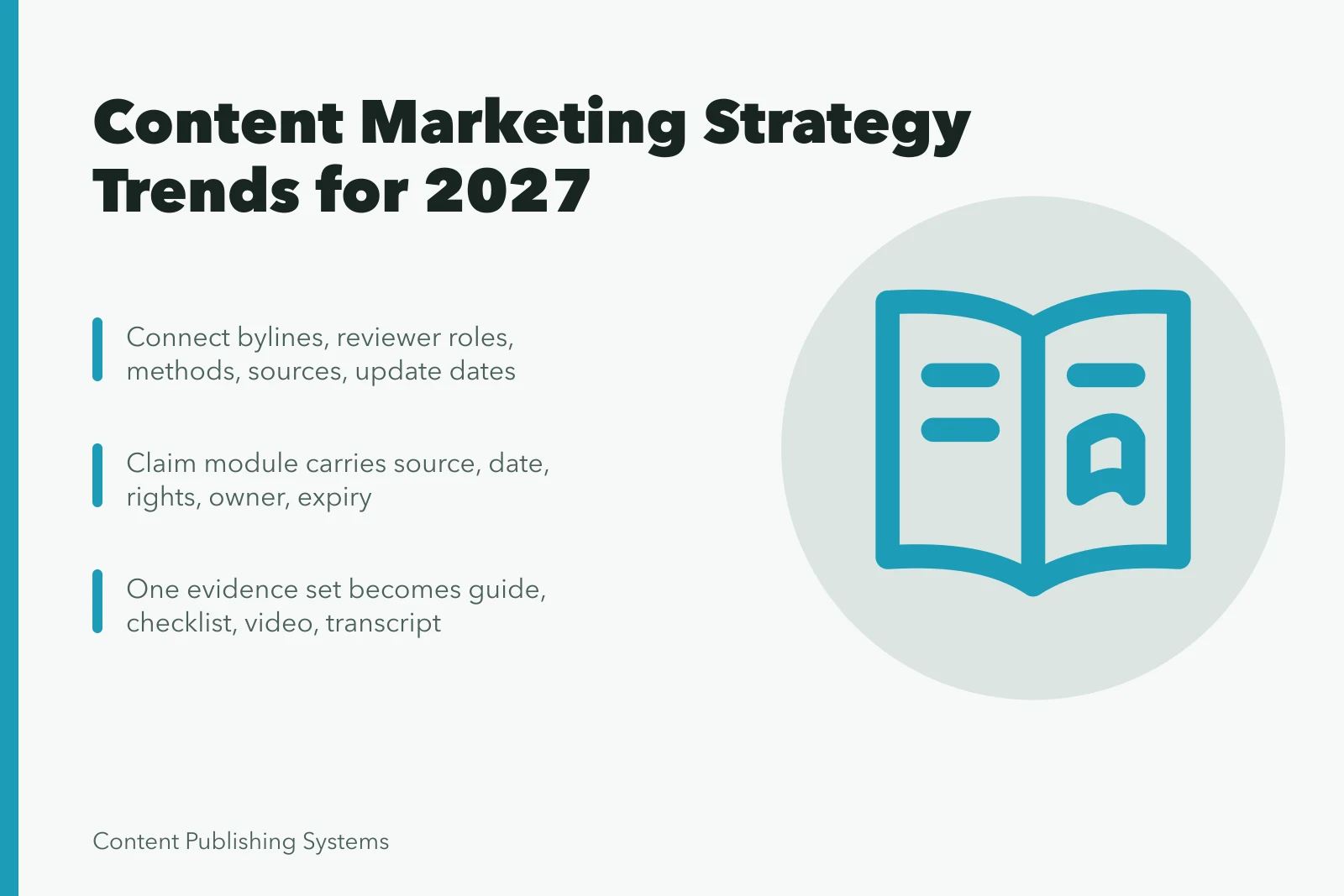
Visible expertise means a named person is answerable
Google's guidance asks who made a page, how, and why. A byline alone does not answer that.
A reviewer role does. So does a methods note: what was tested, on what sample, on what date. So does a correction log that shows what changed after publication.
Assign one accountable name per claim. When a vendor figure is restated, the reviewer confirms the number against the source record before it ships. When a fact changes, the same person signs the correction.
Pilot this on one topic cluster. Measure correction turnaround and how often experts agree to be named. If nobody will attach a name, the claim is not ready.
One workable baseline for a 40-claim cluster: every factual claim carries a named reviewer, and verified corrections ship within two business days.
Reusable evidence beats a rewritten paragraph
A claim module holds the following:
Claim Module Fields
- Wording
- Source
- Date
- Calculation
- Geography
- Rights
- Disclosure
- Owner
Write it once. The number stays the same because there is one number.
Content marketing strategy case studies shows the failure mode: one vendor figure restated with a different value in three articles because each writer re-typed it.
That page is the Content Publishing Systems case study library.
Test whether modules cut contradictions and stale facts. Search your own site for the figure, not the phrase. If the same claim appears in four places with three values, the module is doing its job the day it ships.
Set the target before you search: zero conflicting values for your top 20 figures, checked once a month.
One evidence set, several accessible formats
A guide, a checklist, a calculator, a video, a transcript and a help answer can all come from the same research. Reposting the article six ways is not repurposing.
One Evidence Set, Six Formats
- Research
- Guide
- Checklist
- Calculator
- Video
- Transcript
- Help answer
The W3C Privacy Principles covers data handling in web systems, not content structure. For structure, the standard is WCAG 2.2, a W3C Recommendation since October 2023. It covers real headings, text alternatives, captions and transcripts. It also covers plain instructions and short sentences.
For a US team, treat both as voluntary inputs. NIST AI RMF 1.0 (January 2023) is a risk framework, not a rule. The Justice Department's 2024 ADA rule for public sector websites points to WCAG 2.1 Level AA, and WCAG 2.2 is the current version of that standard. Neither document is a content checklist.
Build the transcript while the video is edited, not after. Captions written from the script cost less than captions written from audio.
Test equivalent task completion: can a reader who uses a screen reader finish the same job as a reader who watches the video? If not, the format is not finished.
Content groups replace page-only reporting
GA4 supports configured content groups. Search Console reports pages and queries with its own limits. Neither tells you whether a cluster of pages answers a problem.
Group by problem, by lifecycle role, by market, by update cohort. Then compare the groups, not the URLs.
Record the definitions, the filters, the canonical handling, the privacy limits and the implementation version alongside the numbers. A group built on a taxonomy that changed in March is two groups wearing one label.
AI assistance gets an evidence gate
Google's AI content optimization guide asks for unique, people-first material, first-hand expertise, organized pages and useful media. It says AI-assisted work still follows Search Essentials and the spam policies.
Google's guidance about AI-generated content dates from February 2023.
The spam policies target scaled content abuse: pages produced mainly to manipulate rankings. Fan-out pages built to catch AI answers sit in the same territory.
Google added scaled content abuse to its spam policies in March 2024.
So put a gate in front of the tools. Research, transcription, outlining and classification can be automated freely. A draft that carries a factual claim needs a named reviewer and a source record before it publishes.
Content marketing strategy best practices treats that gate as one of six required disciplines, not a launch-week extra.
The full list sits in the Content Publishing Systems best-practice guide.
Upkeep is planned capacity, not leftover time
Every published claim has an expiry. Products change, links break, evidence updates, accessibility defects appear, corrections arrive.
Reserve people and budget for those triggers. Google's people-first guidance warns against changing dates or adding and removing content just to look fresh, so the upkeep budget funds fixes, not churn.
Content marketing strategy sets the same expectation at the program level: maintenance is a line item with an owner.
A pilot record you can defend
Keep what improves usefulness, access or accuracy. Retire what adds volume.
| Hypothesis | Pilot evidence | Stop condition |
|---|---|---|
| Visible expertise | Named author and reviewer per claim | No one will sign |
| Reusable evidence | Source record and site-wide figure search | Context is lost |
| Accessible formats | Equivalent task completion | Essential path blocked |
| Content groups | Stable taxonomy and version note | Grouping hides differences |
| AI assistance | Scoped task, review, correction, deletion | Unsupported or copied output |
| Planned upkeep | Capacity, trigger, owner, retirement | Backlog grows |
For each row, name the audience problem, the owner, the baseline, and the measure. Then name the guardrail, the pilot, the stop condition, and the review date. Finally, name the rollback.
Pilot Record and Stop Conditions
Hypothesis
- Visible expertise
- Named author and reviewer
- Reusable evidence
- Source record, figure search
- Accessible formats
- Equivalent task completion
- Content groups
- Stable taxonomy, version note
- AI assistance
- Scoped task, review, correction
- Planned upkeep
- Capacity, trigger, owner
Pilot evidence
- Visible expertise
- No one will sign
- Reusable evidence
- Context is lost
- Accessible formats
- Essential path blocked
- Content groups
- Grouping hides differences
- AI assistance
- Unsupported or copied output
- Planned upkeep
- Backlog grows
Stop condition
- Visible expertise
- Reusable evidence
- Accessible formats
- Content groups
- AI assistance
- Planned upkeep
Common questions
Are these content marketing trends predictions?
No. They are hypotheses drawn from material reviewed in September 2026. Recheck the sources, the products, the policies and your own audience evidence before you commit budget.
Which trend should a team test first?
Pick the smallest reversible pilot tied to your most uncertain decision. Not the one competitors appear to favor, and not the one with the loudest vendor.
How long should a trend pilot run?
Long enough to cover a representative cycle with defined audience, quality, cost and risk measures. Set the stop condition before you start, so the pilot can end early without argument.
Do the NIST and W3C documents tell us what to publish?
No. The NIST AI RMF Playbook offers voluntary AI-risk actions, and the AI RMF Govern Playbook covers policies, roles and oversight. Neither is a content checklist. Add the editorial, legal, rights, privacy, accessibility and security controls your work actually requires.