Strategy
Part of Content Workflow Design for Teams: Roles, Gates, Evidence, and Release
How to Benchmark a Content Creation Workflow
content creation workflow benchmarks for 2027 compare flow, first-pass quality, reviewer demand, release integrity, downstream completion, upkeep, and outcomes.
What to take away
- Build a workflow benchmark from five inputs, in this orderwork class, state list, baseline window, population, then expected and warning ranges.
- One speed measure is enough. Pair median cycle time with first-pass acceptance and revision loops, so speed cannot hide rework.
- Use ranges, not single targets. A small in-house team publishing 12 to 20 articles a month typically sees a median cycle time of 4 to 9 business days.
- Review the ranges quarterly, and sooner after any change in staffing, tools, work mix or obligations.
- Write down what a breach triggers before you publish the range. A range with no owner changes nothing.
Fix the five inputs in order
Definitions come before numbers. Cycle time measured from brief to publish is not the same as the same measure taken from draft to review. Blending the two produces a figure nobody can act on.
The GAO's Agile Assessment Guide metrics chapter separates lead time from cycle time and maps flow state by state.
- Work class.Split net-new articles, updates, video, research, translations and urgent corrections. Averaging them yields a figure no team can act on.
- States.Name each state with its entry and exit event. The content creation workflow checklist uses the same gate list, which keeps revision reasons comparable. Quebec's French-language requirements add a review state that English-only teams miss.
- Window.Use 8 to 12 weeks of history, or 40 completed items, whichever comes first. Leave out the weeks after a tool migration.
- Population.Decide whether staff, freelancers and agencies share one pool. If they do not, keep separate records.
- Ranges.For each metric write an expected range and a warning range, both taken from your own baseline.
[figure 1]
Define editorial states before borrowing metrics
- Document editorial states and work classes
- Define pauses and rework rules
- Set quality guardrails
- Segment articles, videos, research, updates
- Include translations and urgent corrections
Freeze the definitions while the baseline window runs. Moving a state boundary halfway through invalidates the comparison.
Example: one benchmark record
Work class: net-new 1,200-word article with subject review. Baseline window: 8 weeks, 38 published items. The figures below are illustrative ranges for a small in-house team, not published standards.
| Metric | Expected range | Warning range |
|---|---|---|
| Median cycle time, brief to publish | 4 to 9 business days | over 12 days |
| First-pass acceptance at subject review | 70 to 85 percent | under 60 percent |
| Revision loops per item | 1 to 2 | 3 or more |
| Review queue age | under 2 business days | over 4 days |
| Handoffs completed at publish | 95 percent or higher | under 90 percent |
| Post-publish factual corrections | under 2 percent | over 5 percent |
Hold the window and the population steady when you compare quarters. Otherwise the movement you see may come from the sample rather than the work.
Ranges that survive a weak quarter need more design than a single baseline, and setting content planning benchmarks works through that part.
What a breach should change
A rise in median cycle time with flat revision loops and a doubling queue age points at review capacity, not at writing. The answer is a staffing or scheduling change, not a new brief.
Compare the numbers as a group. When cycle time and queue age both rise while revision loops hold, review capacity is the constraint. When revision loops rise with them, the brief or the sources are the problem.
Use medians beside the ranges. One long legal review can drag an average and make a normal month look broken.
Run the first comparison on last quarter's finished items. Keep the record where assignments are handed out, and name the person who refreshes it each month.
When cycle time falls and first-pass acceptance falls with it, reviewers are pushing work through. Sample published pages and check whether the work was read before it shipped.
Send the record to content marketing analytics so a decision to repeat a topic cites workflow evidence beside traffic.
GOV.UK's performance-metrics method fixes purpose and user needs first, then measures, sources and context.
Cadence and reviewer guardrails
Review the ranges quarterly, and sooner after any change to strategy, states, tools, staffing or legal duties.
- Record the share of items approved with no comment, and audit a sample every month.
- Track escaped defects by severity rather than raw count.
- Never set a review speed target that pays a reviewer for approving work.
- Show work in progress beside queue age so a backlog cannot grow unnoticed.
Guardrails matter more than targets here. A reviewer measured on turnaround time will clear the queue, and the defects surface three weeks later as corrections and support tickets. Read the first-pass rate beside the approval rate, because the two move together when review gets thin.
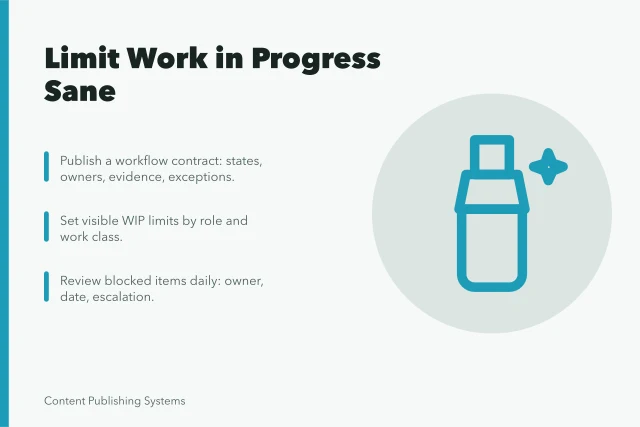
Capping how many items sit in review at once shifts cycle time more than most targets, which is the case made in limiting work in progress.
NIST's design guidance ties the choice of experiment to the objective and to practical constraints, which supports reporting benchmarks apart from controlled effect estimates.
Common questions
What is a good cycle time for a content workflow?
There is no universal number. For small in-house teams publishing 12 to 20 articles a month, a median of 4 to 9 business days from brief to publish is a common band.
Should I compare individual writers by speed or volume?
Usually not with raw figures. Work mix, evidence burden and review demand make those comparisons misleading, and they push people toward easier items.
How often should the ranges change?
Quarterly at a minimum, plus after any change in states, tools, staffing or obligations. Do not move a range in the week it is breached.
How do I stop benchmarks turning reviewers into rubber stamps?
Watch first-pass acceptance beside escaped defects. If acceptance climbs while corrections hold steady, sample the published pages.