Operations
Part of Content Workflow Design for Teams: Roles, Gates, Evidence, and Release
Content Creation Workflow Checklist, Step by Step
content creation workflow checklist for 2027 covers requests, owners, evidence, rights, reviews, versions, accessibility, release, distribution, and upkeep.
What to take away
- A content creation workflow checklist runs step by step at intake, before material review, before release, and after any change to claims, rights, access, market, owner, format, channel, or risk.
- A gate is a defined checkpoint a deliverable must cross with its evidence, owner, date, and next action attached.
- The operating owner is one named person who holds the checklist and its gate records; specialists keep their limited review.
- Record pass, fail, assigned, or not applicable with a reason; do not turn missing evidence into silent approval.
- A checked box records a decision only when its scope, reviewer, evidence, and follow-up remain available to the people relying on it.
A content creation workflow checklist should confirm that a deliverable can cross each production gate without losing evidence, ownership, or approved meaning.
One-page gate checklist
Use this table at the gate. Times are typical per asset and depend on size, markets, and reviewer count.
| Gate | What to sight | Typical working time |
|---|---|---|
| Brief | Signed brief: ID, owner, market, risk, next action | 20 to 40 minutes |
| Evidence and rights | Source list, permission records, disclosure text | 1 to 3 hours per asset |
| Production and review | One authoritative version, routed decisions, open blockers | 1 to 3 working days |
| Access and quality | Journey test notes, exception register | 2 to 4 hours |
| Release | Release record: version, approvals, rollback, redirects | 30 to 60 minutes |
| Aftercare | Monitoring and refresh owner named | 20 to 30 minutes |
Request and brief
Brief Intake Fields
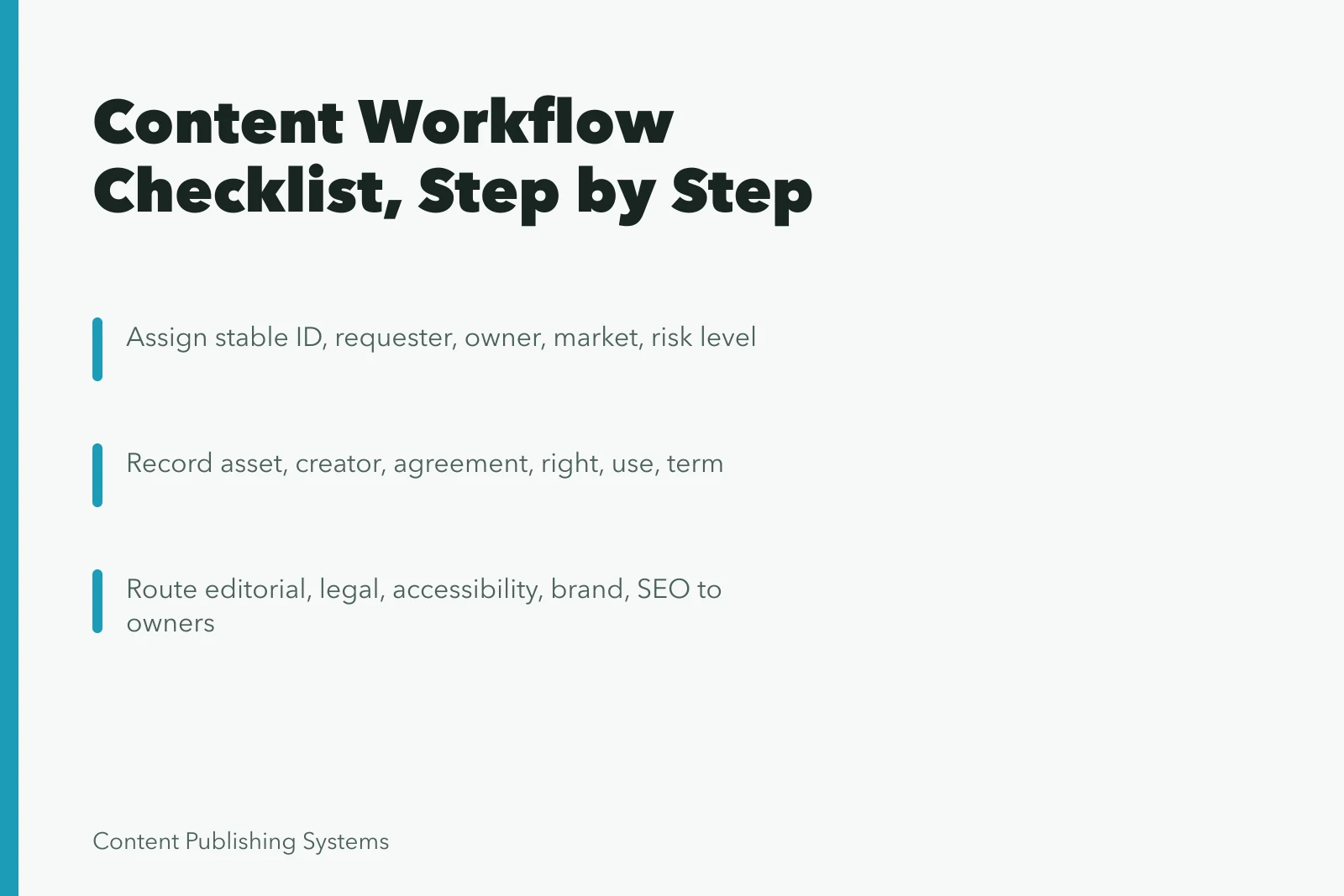
- Stable ID, work type, requester, production owner
- Market, parent initiative, risk level
- Audience, situation, question, promise, objective
- Scope, exclusions, format, channel, next action
- Author, contributors, factual owner, reviewers
- Release authority, publisher, backup
- Milestones, dependencies, handoff, measurement, refresh
- Assign a stable ID, work type, requester, production owner, market, parent initiative, and risk level.
- Confirm audience, situation, question, promise, objective, scope, exclusions, format, channel, and next action.
- Name the author, contributors, factual owner, required reviewers, release authority, publisher, and backup.
- Record milestones, dependencies, distribution handoff, measurement decision, and refresh trigger.
Evidence and rights
The U.S. Copyright Office's copyright ownership and transfer chapter states that copyright initially belongs to an author, identifies the U.S. work-made-for-hire rule, allows rights to be transferred separately, and distinguishes copyright ownership from ownership of the material object containing the work. The checklist therefore records the exact asset, creator, relationship, agreement, right, use, market, and term.
- Open primary sources and confirm that each supports the exact claim, date, method, market, and limitation.
- Separate direct evidence, inference, opinion, and promotional claims in the review record.
- Confirm permissions for customer material, quotations, images, logos, recordings, data, and translations.
- Mark sponsored, affiliate, partner, customer-influenced, and product-led content with its required disclosure.
Skipping the brief stage entirely is one of the most common content creation workflow mistakes: production starts before scope, exclusions, and the next action are named.
Production and review
- Draft from the reader task and preserve qualifications, counterexamples, and necessary uncertainty.
- Use one authoritative version with status, owner, timestamp, source links, and material change history.
- Route editorial, expert, legal, accessibility, brand, and SEO questions to their defined decision owners.
- Require comments to identify the passage, issue, reason, evidence, required action, and whether they block release.
Access, adaptation, and quality
W3C's form-control labeling tutorial explains that labels should identify controls and normally be associated through matching label and control identifiers. It also discusses buttons, visible labels, mobile placement, and relevant WCAG criteria. Use it as a specific production check for forms, then test the full journey: instructions, errors, keyboard behavior, assistive technology, language, and responsive layout.
- Check semantic headings, meaningful links, text alternatives, captions, transcripts, clear instructions, and accessible downloads.
- Give designers and localizers context, terminology, rights, claims, layouts, variables, disclosures, and change notices.
- Verify facts, links, metadata, privacy, rights, rendering, calls to action, tracking, and rollback readiness in the real environment.
- Record every accepted exception with approver, reason, consequence, owner, remediation, and expiry.
Release and aftercare
- Record the approved release version, final location, publisher, timestamp, approvals, redirects, and known limitations.
- Give distribution owners approved variants, audience, disclosure, timing, rights, tracking, expiry, and response guidance.
- Test measurement where permitted and preserve source, filters, baseline, observation window, limitations, and decision rule.
- Assign monitoring, corrections, refresh, consolidation, redirect, archive, or retirement responsibility before closing the workflow.
Measurement note: a content creation workflow benchmarks set explains why a raw cycle time or approval speed means nothing without the work class and population attached.
Do not mark the work complete because a file exists.
Checklist disposition record
One filled example:
| Status | Evidence required | Next action | Worked example: a partner case study claim |
|---|---|---|---|
| Pass | Scope, reviewer, proof, date | Advance and monitor | One claim on one page; factual owner read it on 4 March; vendor sheet on file |
| Assigned | Gap, owner, due date, dependency | Resolve before gate | Customer sign-off missing; factual owner; due five working days before release |
| Fail | Material defect or contradiction | Stop, correct, or cancel | Vendor sheet contradicts the claim; hold the page |
| Not applicable | Reason and authorized reviewer | Recheck after change | No personal data on the page; rights reviewer; recheck if a testimonial is added |
Gate result: privacy and acquisition checks
The W3C Privacy Principles statement gives web-system designers shared privacy concepts and warns against shifting privacy work to individuals. Apply it to this content creation workflow checklist at the release line that checks facts, links, metadata, privacy, rights, rendering, and tracking.
The CISA software acquisition fact sheet covers development practice, supply-chain exposure, deployment, and vulnerability management. Add those government-acquisition questions to the rights line that confirms permissions for customer material, data, and translations, without treating them as local approval.
Common questions
Does a checklist guarantee a correct article?
No. It records defined controls that were examined. New evidence, hidden defects, misunderstood scope, platform changes, or implementation errors can still require correction.
Who owns the workflow checklist?
Name one operating owner and preserve each specialist's limited review. One signature should not imply approval of facts, rights, access, privacy, and release outside that person's scope.
When should the checklist be repeated?
Repeat affected checks when claims, sources, contributors, assets, rights, audience, market, design, code, channel, data, owner, obligation, or risk changes materially.