Reviews
Part of Content Workflow Design for Teams: Roles, Gates, Evidence, and Release
Should Every Reviewer Approve a Content Workflow Stage Before It Ships?
content creation workflow questions for 2027 clarify boundaries, stages, owners, briefs, reviews, versions, automation, publishing, measurement, and upkeep.
What to take away
- Eight questions define where a workflow starts and ends, which stages matter, who owns decisions, and what evidence makes a brief ready.
- A tool may route work and preserve records, but it cannot decide whether a material claim, right, disclosure, or release is acceptable.
- The workflow continues until publication records, distribution, measurement, correction, and maintenance responsibilities are assigned.
Content creation workflow questions usually concern ownership and gates rather than writing technique. These answers establish a practical baseline.
Where should a workflow begin and end?
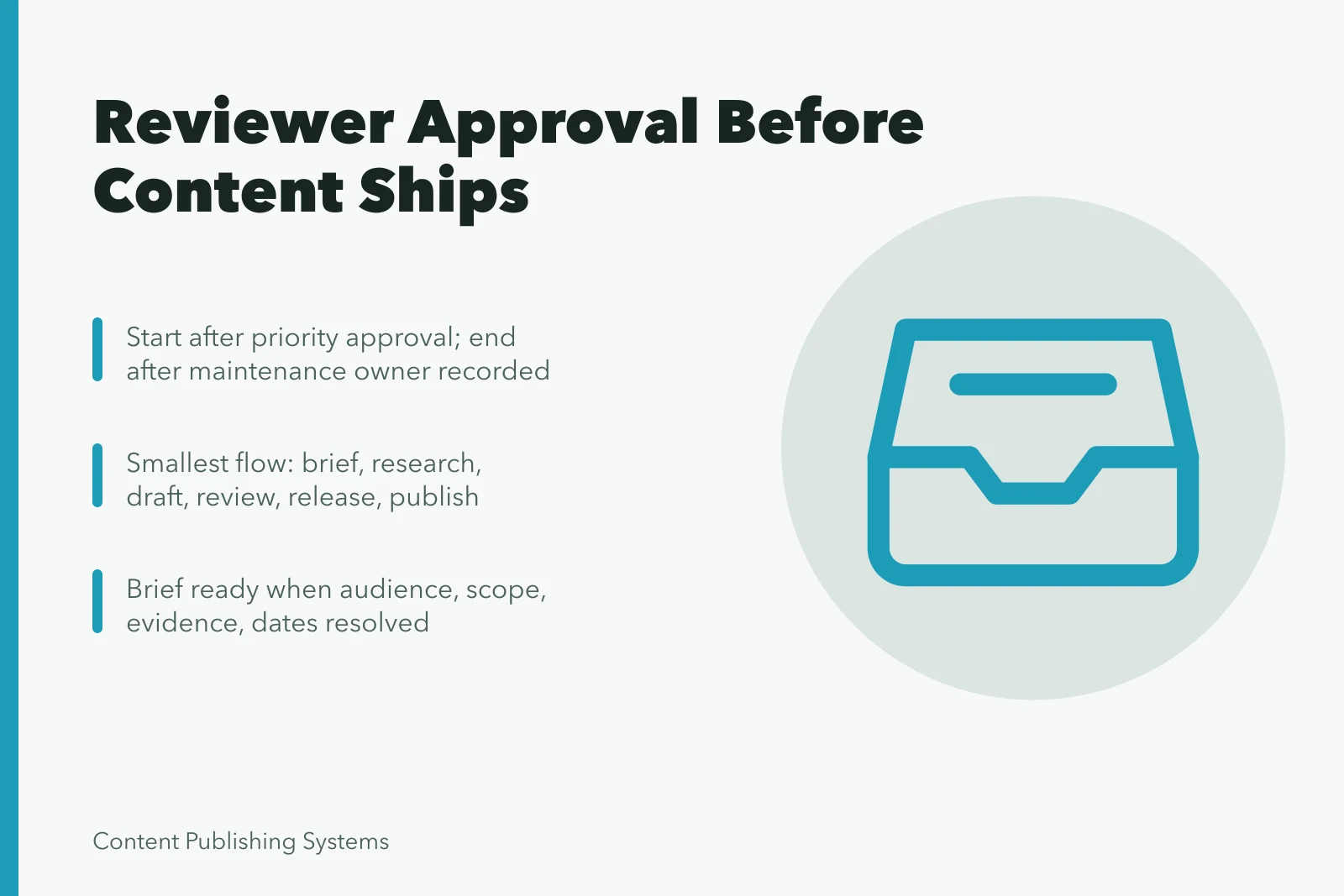
Begin after the work has passed priority approval and has a defined requester, audience, purpose, market, and owner. End after the final asset, approvals, source record, distribution handoff, measurement setup, and maintenance owner are recorded.
How many stages are enough?
Smallest Real-Decision Workflow
- Brief approval
- Research
- Draft
- Specialist review
- Revision
- Release approval
- Publishing
- Maintenance
Most business workflows need four to six stages before publication, plus aftercare. Each stage needs an entry condition, an exit condition, an owner, and the record it produces. Fewer stages hide real decisions. More stages add gates that change nothing. The figure shows a ten-stage route for work that crosses several markets.
Who owns each article?
Digital.gov's digital-governance overview defines governance for U.S. federal digital work through operating rules, responsibilities, lines of authority, and mechanisms that make those rules effective.
A business content workflow can borrow that accountability pattern, but it must define its own decision rights, risks, markets, and evidence rather than copying a federal agency structure.
Assign one production owner who coordinates the record, plus named owners for material facts, legal or compliance decisions, accessibility, publication, distribution, analytics, and upkeep.
What makes a brief ready?
The audience task, promise, scope, exclusions, evidence, original contribution, format, channel, next action, author, reviewers, due dates, access needs, disclosure, measurement, and refresh trigger are resolved. A guide to managing content creation workflows turns that checklist into a published contract with named states.
Should every reviewer approve everything?
No. Editorial, subject-matter, legal, brand, accessibility, SEO, and production reviews answer different questions. Define which are required by risk and work type.
A simple rule of thumb: a new or high-risk asset gets legal, compliance, and accessibility review, while a routine update needs the owner and one editor. Raise the level when a change touches a material claim, a right, a disclosure, or a release date. Reviewers should comment within their decision rights and identify blocking issues, evidence, and required changes.
How should versions be controlled?
Keep one authoritative working copy with status, owner, and timestamp. Preserve important approval and release versions, source evidence, and material change history. Limit uncontrolled downloads and parallel edits. Test recovery and rollback for valuable or high-risk assets.
Can workflow tools automate approval?
They can route and record decisions, but an automation should not substitute for qualified judgment. Work trackers such as Jira, Asana, or Monday.com hold tasks, owners, and due dates. Approval chains inside a CMS such as WordPress or Drupal gate publication. Digital asset managers hold rights, versions, and release records.
Use the tool for reminders, templates, validation, and predictable transitions. Require accountable review for facts, rights, disclosures, access, privacy, security, and release.
What happens after publication?
GOV.UK Service Manual's service-team role guide separates product, service ownership, delivery, research, and content, and describes content review for accuracy, relevance, accessibility, and style. These are government-service roles, not a universal org chart. Use them to test for missing decisions, then fit real team's size and risk.
Confirm the actual location, release version, tracking, distribution, and owner. Monitor for defects, then review performance at a defined time using consistent measures, the kind content marketing analytics ties to a named decision, not a raw count. Set clear triggers for scheduled updates, consolidation, redirects, archive, or retirement.
Eight-question workflow test
| Question | Record to inspect | Weak answer |
|---|---|---|
| Boundary | Start, finish, dependencies | From idea to done |
| Stage | Decision, entry, exit, owner | Drafting and review |
| Control | Evidence, exception, approval | The tool handles it |
| Aftercare | Distribution, measure, upkeep | Published means closed |
Resolve the question with a decision record
The GAO evaluation design guide connects evaluation questions with evidence needs and design choices. Apply that discipline here; federal evaluation guidance does not make a local marketing result causal or transferable. Keep the record next to the content plan that already names the item's owner.
A short worked record for a claim might read like this:
Resolve with a decision record
- Questioncan the energy-saving claim ship?
- Evidencethe supplier test report and its date.
- Decisionhold the claim until the signed report arrives.
- Ownerproduct marketing lead.
- Review scopelegal and subject matter.
- Next reviewthe date set in the content plan.
The W3C Privacy Principles statement gives web-system designers shared privacy concepts and warns against shifting privacy work to individuals. Apply it here, then review the governing law and configuration.
Common questions
Should every article follow the same workflow?
No. Preserve the core control purposes, then vary the route by work type, market, evidence, rights, access needs, consequence, and release risk.
Can a small team combine workflow roles?
Yes. One person may hold several roles. Each role still needs a backup who can act when that person is away.
When should a workflow be changed?
Change it when recurring waiting, defects, unclear ownership, unnecessary review, new obligations, tool limits, or downstream failures show that a control no longer works.