Strategy
Content Publishing Systems for Regulated US Teams: What to Check First
How US teams build approval gates, audit trails, and retention into content publishing systems for regulated industries, plus a governance checklist.
What to take away
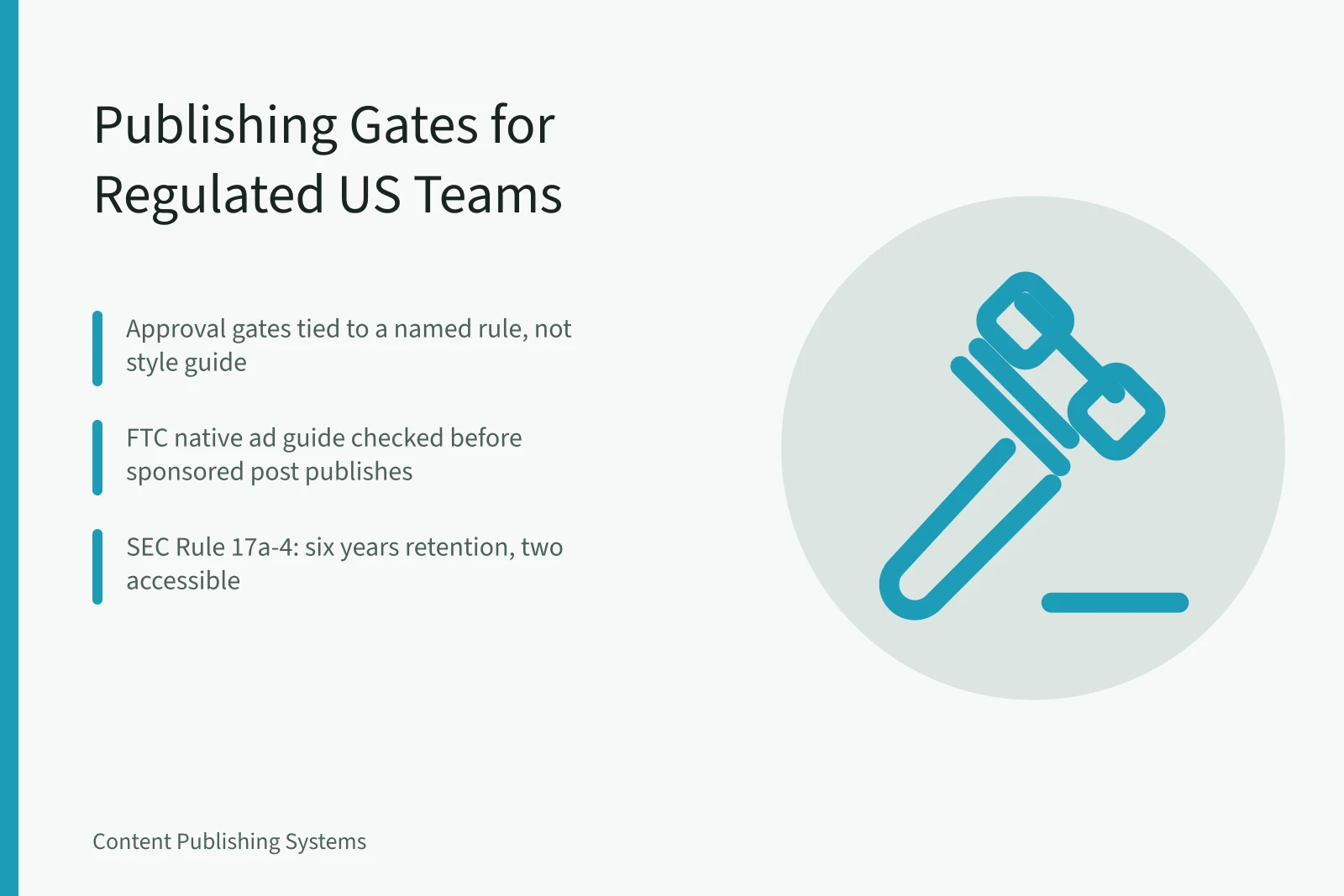
- Content publishing systems for regulated industries in the US need approval gates tied to a named rule, not a general style guide.
- The platform holds the gatesrole permissions, required fields, blocked publish states, and fixed version history.
- Audit trails must show who approved which version, when, and against what evidence.
- Health, financial, children's, and sponsored content each carry different gate requirements.
- Configure gates before migrating old posts, because retrofitting them later costs more.
Where US rules touch the publishing system
US advertising rules arrive from several agencies at once. The Federal Trade Commission polices deceptive claims under Section 5 of the FTC Act. A paid post that reads like editorial falls under native advertising disclosure expectations.
Audits should test sponsored placements against the FTC native advertising guide before publication rather than after a complaint.
Financial firms answer to FINRA Rule 2210, which requires a registered principal to approve retail communications before use. Investment advisers face the SEC marketing rule, which limits testimonials and requires net performance figures.
Health and supplement content faces a separate evidence bar. The FTC health products compliance guidance describes the substantiation standard reviewers apply to product claims.
Content that collects data from children pulls in COPPA, which requires verifiable parental consent and clear notice of data practices.
Approval gates to configure by risk tier
Not every post needs three reviewers. A regulated industry content workflow differs from a general one in three places: who can publish, what must be attached, and what gets stored.
Approval Gates by Content Type
Content type
- Supplement or device claim
- Regulatory reviewer
- Sponsored or affiliate post
- Disclosure check
- Financial promotion
- Registered principal
- Child data capture
- Privacy review
Gate before publish
- Supplement or device claim
- Citation, reviewer name
- Sponsored or affiliate post
- Disclosure text, placement
- Financial promotion
- Approval date, version
- Child data capture
- Consent copy, data flow
Evidence kept
- Supplement or device claim
- Sponsored or affiliate post
- Financial promotion
- Child data capture
Two settings make those gates real. A required field blocks publishing until the reviewer enters a name, and a role permission stops an author from approving a personal claim. A CMS approval workflow for compliance usually lives in those settings, not in a shared document.
Audit trails and retention settings
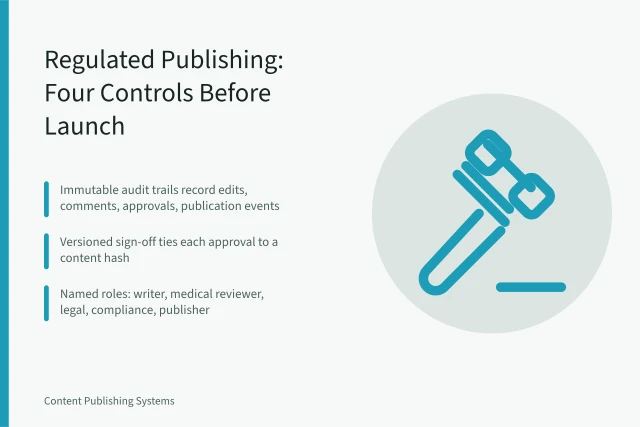
Approval records matter only if the system keeps them intact. Look for version history that cannot be overwritten, reviewer identity tied to a named account, and timestamps in one fixed time zone.
FDA 21 CFR Part 11 sets expectations for electronic records and signatures in life sciences work. SEC Rule 17a-4 requires broker dealers to preserve certain records for six years, with the first two years readily accessible. Default CMS retention rarely matches those windows.
Plan an export path. A PDF of the approved page plus the approval log often satisfies a legal review, but only if the platform can produce it on demand.
Content publishing governance checklist
Publishing Governance Checklist
- Regulated claim field required before publish
- Reviewer role separate from editor role
- Rejected drafts return with written reason
- Approved versions immutable and exportable
- Retention window matches strictest rule
- Freelancer briefs name approver and evidence
Example: one supplement claim through three gates
Example: a supplement brand drafts a post saying a magnesium blend supports sleep.
Three Gates for a Supplement Claim
- Draft: magnesium blend supports sleep
- Gate 1: Medical reviewer approval
- Gate 2: Affiliate disclosure check
- Gate 3: Final publish gate
- Audit log: R. Ortiz, Version 4
Audit log entry: "Sleep support claim approved. Study citation attached. Net effect language removed. Reviewer: R. Ortiz. Version 4, 14:02 UTC."
The draft passes a medical reviewer first, then a disclosure check for the affiliate link, then a final publish gate. Each step is a separate permission in the CMS, not a message in a chat thread.
Rolling the workflow across teams and platforms
Teams serving oil and gas add provincial rules on top of federal ones. Calgary content marketing for energy and regulated industries collects AER disclosure wording, Competition Bureau review steps, and named association requirements that sit beside the US gate model.
Cross-border teams also inherit Canadian rules for commercial email and privacy, and the same gate model can absorb them.
If the plan is still unwritten, content marketing strategy for 2027 shows how audience needs, evidence, formats, and governance connect before you buy software.
Platform choice follows gate design. Headless CMS for content teams explains when portability and syndication justify a headless build over a WordPress plugin stack.
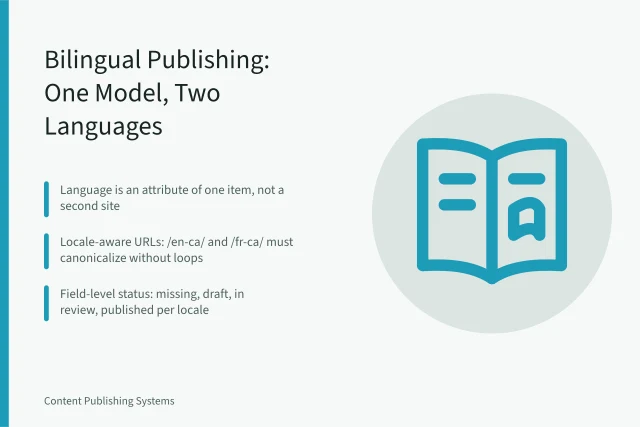
Toronto content publishing systems shows how bilingual calendars and translation handoffs attach to the same approval chain for English and French clients.
When briefs go to freelancers, name the approver and the evidence they must attach, following general guidance from the U.S. Small Business Administration on managing contractors.