Strategy
Headless CMS Migration for Bilingual Canadian Content Teams
The step by step guide to moving English and French content into a headless CMS, from inventory audit and locale modelling to translation workflow design and cutover
What to take away
- A headless CMS migration for bilingual content is four projects: inventory, locale modelling, workflow design, and cutover.
- Quebec language rules and your translation budget shape the model more than the vendor shortlist does.
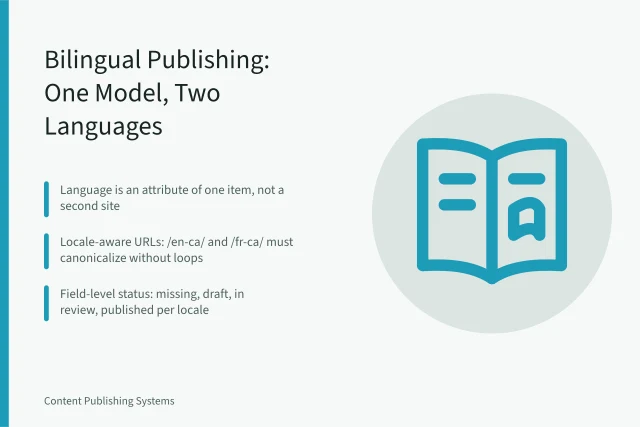
- English and French normally live as locale entries inside one content type, not as two parallel websites.
- Pilot one section, measure translation turnaround, then migrate in waves with a rollback window.
Audit the library before you shortlist a vendor
Migration projects fail at the inventory stage more often than at the build stage. Export every URL and record its language, last edit date, traffic, and page owner. Flag pages that exist in only one language, because those gaps drive the plan.
Content Audit Fields
- Export every URL
- Record language
- Record last edit date
- Record traffic
- Record page owner
- Flag single-language pages
A content audit is the fastest way to decide what moves, what merges, and what gets retired. Most bilingual libraries carry duplicate pages and abandoned translations. Retiring them first shrinks the schema you have to build.
Constraints come next. Legal review, brand approval, and translator capacity set your real publishing speed. Settle those inside a content marketing strategy before any vendor demo, because software only automates decisions you already made.
Model locales instead of duplicating pages
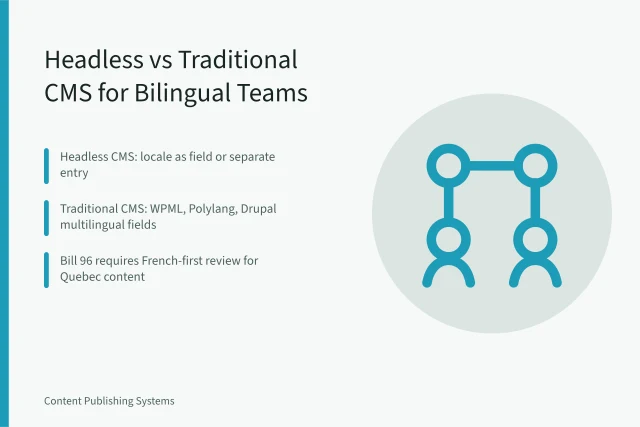
Headless CMS decouples storage from presentation, so one content type can hold both languages. Choosing a bilingual content management system in Canada comes down to locale handling, not brand recognition.
Bilingual Locale Decisions
Decision
- Locale storage
- Locale fields on one entry
- URL pattern
- /fr/ prefix on French paths
- Slug style
- Translated French slugs
- Fallback
- Block publish until French exists
- Translation flow
- Human translator with machine assist
Common choice
- Locale storage
- Publish both from one record
- URL pattern
- Search and analytics stay separable
- Slug style
- Readable links for French readers
- Fallback
- Stops English leaking into Quebec
- Translation flow
- Raw output degrades marketing copy
Why it matters
- Locale storage
- URL pattern
- Slug style
- Fallback
- Translation flow
Common bilingual choice
- Locale storage
- Locale fields on one entry
- URL pattern
- /fr/ prefix on French paths
- Slug style
- Translated French slugs
- Fallback
- Block publish until French exists
- Translation flow
- Human translator with machine assist
Why it matters
- Locale storage
- Editors publish both languages from one record
- URL pattern
- Search and analytics stay separable
- Slug style
- French readers get readable links
- Fallback
- Stops English leaking into Quebec pages
- Translation flow
- Marketing copy degrades under raw output
Localization is not translation. It covers tone, currency, units, legal wording, and the names of things that differ between markets.
Tooling is largely settled. Contentful, Sanity, Storyblok, and Strapi all handle locales. Translation connectors such as Phrase, Lokalise, and Crowdin push entries out to translators and pull them back.
If portability and syndication drive your decision, headless CMS for content teams compares WordPress and custom builds on cost and workflow.
Move in six phases
Treat this as your content publishing system migration checklist.
- Freeze the new-page backlog for the sections you plan to move first.
- Export content, media, and metadata into structured files, not page dumps.
- Build the locale schema, then connect the glossary and translation memory.
- Run one pilot section with a single translator and a single approver.
- Map redirects from every legacy URL, French paths included.
- Cut over in waves and keep the old CMS read-only for the rollback window.
Your headless CMS English French workflow decides who writes first and who signs off. Write that sequence down before the build starts.
Do not skip the redirect file. Every legacy URL needs a matching destination, and French URLs must never fall back to English pages.
Example: a Toronto agency bilingual CMS setup
Picture a Toronto agency with a client selling into Ontario and Quebec. The library holds 900 URLs, 600 English and 300 French. The pilot covered product pages only, with English drafted first and French filled within two business days. Four weeks later the agency moved the remaining sections and retired 140 stale URLs.
Regulated sectors, Quebec rules, and review layers
Quebec's Charter of the French Language requires French to be markedly predominant in commercial signage and gives consumers a right to be informed and served in French. That shapes templates, not just copy.
Teams running Calgary content marketing for energy programs add a legal checkpoint inside the publish flow. AER disclosure, Competition Bureau claims, and named industry associations all create approval steps.
The headless CMS vs traditional CMS question in regulated industries turns on audit trails. Structured content with locale fields is easier to review than page builders with plugin sprawl.
Editorial calendar and translation handoff
Toronto content publishing systems blend bilingual editorial calendars, translation handoffs, and approval chains for clients serving English and French markets. A shared calendar keeps French from becoming a last-minute rewrite.
Plan governance at the same time. Decide who owns the glossary, who approves French, and how often the schema gets reviewed. A CMS cannot answer questions about audience, formats, or measurement on its own.